

Five lines you can use
“The answer key is ready. My ability to pronounce everything is still under review.” “There are no wrong answers in the wishes cards. The trivia round is a different story.” “This round is ten minutes long, so your cake has nothing to worry about.” “You may phone a friend, but they are probably already at your table.” “Our grand prize is applause. The chocolate is a welcome extra.”
Decide what the joke is doing
A bridal shower joke has a small job. It can help you gather attention, make an instruction less stiff, or move gently from one activity to another. It does not need to prove that you are a comedian. Before choosing a line, ask what comes immediately after it. If you need guests to pick up a pen, the line should lead toward that action. If you are introducing a toast, it should leave room for the person you are celebrating. A joke that needs a long explanation can interrupt both jobs. Write the practical instruction first, then decide whether a lighter opening improves it. Sometimes the plain instruction is the better choice, and that is a perfectly good hosting decision.
Think about the difference between a joke about the situation and a joke about a person. “The pens are ready; my ability to add scores is still warming up” makes the host's small task the subject. “We all know who will get the lowest score” appoints a guest as the subject before they have agreed to it. The first can be dropped without affecting anyone. The second may leave someone waiting to be embarrassed. You cannot predict every reaction, but you can choose material that does not depend on another person's discomfort. The sample lines here are optional suggestions. None is a promise that a particular audience will laugh.
Learn the boundaries without requesting secrets
Ask the guest of honor one simple question while planning: “Are there any subjects you would rather we leave out?” You do not need a list of private stories to create a pleasant introduction. Names, the general order of the day, and the fact that people have gathered to celebrate usually provide enough material. If someone offers an anecdote, ask whether the people in it know it will be shared. Permission from the storyteller is not automatically permission from everybody mentioned. Keep a second, impersonal line available so removing a personal story does not create a hole in your script.
Give yourself a clear exclusion list. Appearance, fertility, finances, former relationships, family arguments and unwanted marriage advice do not need to become the entertainment. Avoid making the absence of a relative or partner into a punchline, because you may not know why they could not attend. The same applies to jokes about who paid for the event or who has not brought a gift. These topics are not necessary for a warm welcome. If a line only works after saying “They won't mind,” pause and ask whether you actually know that. A joke about your stack of answer sheets is much easier to replace than a joke that reveals something personal.
Build a short opening that sounds like you
An opening can have three parts: a welcome, one light sentence and the next instruction. For example: “Thank you for coming to celebrate Sam. I have a schedule, but the cake has requested a little flexibility. Please help yourself to a drink while everyone arrives.” The practical meaning is still clear even if nobody reacts to the middle sentence. Read the opening aloud once. If you would not normally use a word, replace it. A polished line is less useful than one you can say without sounding as though you borrowed somebody else's personality.
Do not turn the welcome into a tour of the guest list. Introducing every friend with a teasing description can take longer than expected and gives people no easy way to opt out. Instead, introduce helpers by their role: “Jordan is looking after the music, and Lee can help with the game cards.” If you want a lighter addition, direct it at the work: “Between us, we have located the pens, which feels like a promising start.” Then move on. The welcome has succeeded when people know they are in the right place and understand what happens next, whether or not it produced laughter.
Five opening lines and when to use them
“We have food, friends and a short game. In that order, because I respect priorities.” This can fit a relaxed meal when food really is coming first. Do not use it if service has been delayed and guests have been waiting; the same words may draw attention to a frustration rather than relieve it. Follow it with a clear direction about drinks or seating. A line tied to the real schedule is easier to deliver than one that asks people to imagine a situation that is not happening.
“The decorations are coordinated. The hosts are doing their best.” This puts the hosts, rather than guests, in the joke. It works as a passing remark, not an apology for everything that might happen. You do not need to keep telling people that you are nervous or disorganized. Once you have said it, give the next instruction confidently. If the event is formal or the hosts prefer a straightforward tone, leave it out. The line should support the atmosphere you have chosen, not force the event into a casual style.
“Welcome. You have already completed the first challenge: finding the entrance.” Only use this if finding the venue was an ordinary inconvenience, not an access problem or a genuinely difficult journey. It should never tease somebody for arriving late. You can soften it further by including yourself: “I found the entrance on my second attempt, so I am impressed with all of us.” Then thank people for making the trip. Gratitude should remain the main message, especially when guests have traveled a long way or rearranged their day.
“Today is about celebrating the couple. My spreadsheet has been informed that it is not the guest of honor.” This can suit a host whose friends know they like planning. It does not require revealing anything about the couple. Keep the follow-up practical: explain the broad order of activities and let people settle in. If you have not actually used a spreadsheet, you can say “my schedule” instead. Small adjustments like that make a prepared line easier to say naturally and avoid pretending to have an elaborate personal story.
“Please make yourselves comfortable. The cushions have no formal seating plan.” Use this for a home gathering where guests really may choose where to sit. It would be confusing at a venue with assigned places. This illustrates a useful rule for all the examples: humor must not contradict instructions. If seats are reserved for access needs or specific guests, explain those clearly. You can still be warm without making the seating arrangement into a joke. People should never have to decide whether an important direction was serious.
Introduce a game without overselling it
Avoid announcing that the next game is “the funniest thing ever” or that even people who hate games will love it. Those promises make a modest activity carry unnecessary weight. Say what guests will do and how long the activity block is expected to last. For example: “We will try a short guessing round. The answers are on my sheet, which is the only reason I look confident.” Then explain the rules. The joke should not replace the rules or imply that you will change them for entertainment. If you are awarding points, tell guests how matching answers and ties will be handled.
For a shared browser quiz, a suitable line is: “I will press the buttons; you get to have opinions about my choices.” Follow that immediately with the actual format. Are guests voting on one group answer, or writing individual guesses before the host reveals the result? These are different ways to play. The score on one shared screen does not automatically tally every guest. If a helper is keeping separate totals, introduce them. Humor about clicking the screen is fine; suggesting that the website can identify the cleverest person in the room would create a false expectation about the game.

Use jokes around scoring carefully
Scores are easiest to enjoy when the rules remain predictable. “The answer key has declined all negotiations” can work before the reveal, but you still need a sensible rule for equivalent wording. A guest who writes “café” when the prepared answer is the name of that café may deserve the point under your announced rules. Decide that approach beforehand. Do not deny a reasonable answer simply to continue the joke. If the round is deliberately unscored, say so. A playful phrase cannot repair the frustration of discovering that the host has been changing the competition while people were trying to participate.
For a tie, try: “We have more correct answers than I prepared prizes for. That is a respectable problem.” Then use the plan you made in advance: joint winners, a shared prize or one agreed extra question. Do not invent a personal dare for the tied guests unless that was clearly part of the activity and they want it. You can also remove the prize issue entirely: “These totals match, so we are naming joint winners.” A straightforward result often feels better than stretching a light game into an unexpected contest just because the host wants another amusing moment.
Keep toasts warm and brief
A toast can include a light observation, but the final thought should be about the people being celebrated. One possible structure is: “Thank you for bringing us together. We hope your shared adventures include good company, manageable luggage and plenty of reasons to celebrate. To you both.” The luggage phrase is an optional playful detail, not a statement about anybody's habits. Avoid stacking several jokes before the toast. Guests may be holding drinks or waiting for food, and the couple should not have to wonder when the message will become sincere.
Do not use a toast to deliver advice disguised as comedy. Lines about one partner always being wrong, losing freedom after marriage or learning to tolerate the other person may not fit the relationship being celebrated. You can choose something more specific and generous without inventing a personal history. Mention the pleasure of seeing friends and family together, a shared interest the couple has approved, or a wish for time to enjoy ordinary days. If you are not close enough to offer a personal story, a simple congratulatory message is more appropriate than borrowing one that sounds intimate.
A worked example: the joke does not get a reaction
Imagine that you say, “The answer sheet is ready; my arithmetic is on standby,” and the room stays quiet. Nothing needs to be rescued. Continue: “Write one answer for each question, and we will check them together afterward.” People may have been finding a pen, talking to a neighbor or simply listening. Repeating the line more loudly can make the moment feel larger than it was. Asking “Tough crowd?” shifts responsibility to the guests and can make them feel they were supposed to perform a reaction for you.
Afterward, adjust the rest of your script if that seems helpful. Use fewer humorous lines and more direct transitions. That is responsive hosting, not a failed performance. Keep the parts of the event that matter: clear instructions, the couple's comfort and time for people to connect. A host does not need to earn a certain number of laughs. You can be friendly by remembering names, helping someone see the screen or making sure a guest has a seat. Those actions often do more for the experience than another attempt at a punchline.
If a joke lands badly, stop adding to it
If someone looks uncomfortable or tells you a line was unwelcome, do not explain why it was supposed to be harmless. A brief response such as “I'm sorry; let's leave that topic” is enough to move away from it. Avoid asking the person to confirm in front of everyone that they are fine. Return to a neutral instruction or take a short break. Later, if appropriate, check in privately without making them responsible for reassuring you. The important action is changing the behavior, not defending the intention.
You can prevent some awkward moments by giving helpers a simple signal for moving on. Perhaps your co-host will say, “We have the next activity ready,” if a speech or conversation becomes uncomfortable. Agree on that privately before the event. It is not a system for policing every spontaneous comment; it is a way to keep the host from feeling trapped in a moment that no longer serves the celebration. Keep a neutral transition on your card so you can use it without thinking: “Thank you. We are going to move on to the next part of the afternoon.”
Adapt the delivery for a video call
On a video call, leave a short pause after a light line rather than immediately talking over the response. Some guests may be muted, and others may show a reaction without speaking. Do not interpret silence as disapproval. If you need everyone to understand an instruction, put it on screen or repeat the practical part clearly. The joke is optional; the direction is not. Avoid wordplay that only makes sense when people can see an object you are holding off camera. Check with a helper that the relevant item or text is visible before referring to it.
For chat-based play, keep teasing away from typing speed and spelling. A guest may be using a phone, a different keyboard or a language they do not usually write in. You can say, “Please wait to send until I count down,” without turning an early answer into a public mistake. If someone sends a guess too soon, reset the instruction calmly. A useful light line is about the format itself: “The chat is enthusiastic; I will give it a starting signal.” Then provide that signal. Do not keep returning to the individual who pressed send first.
Let guests contribute without creating a roast
If you invite guests to supply jokes or light memories, explain the boundary in the invitation. Ask for a short, kind contribution that the people mentioned are comfortable sharing. Collect it privately beforehand when possible. This gives you time to remove something that depends on an inside story, private information or a person who is absent. You do not have to read every submission aloud. Tell contributors that you may use only a few to fit the schedule so editing the list does not feel like a personal rejection.
Another option is to ask for playful wishes rather than jokes. “May your road trips include good snacks and correctly packed chargers” is a wish that does not require a target. Guests can write their own version, and the couple can choose whether to keep it private or hear a few examples. This is a manual activity you can prepare with paper; it is not a claim about an extra feature in a browser game. If you read a card aloud, ask the writer's permission first and avoid assigning a name to an anonymous contribution.
Prepare a small cue card
Write the opening, one game introduction, one neutral transition and the closing on a single card. Put the practical instruction in larger text than the joke so you can find it quickly. Include pronunciations of names if you need them. Mark any personal story with a reminder that permission was obtained; if permission is uncertain, remove it. You do not need a script for every minute. A small set of dependable lines leaves you free to listen to the room instead of searching through a long document while guests wait.
Read the card aloud with a helper before the event. Ask two questions: “Is the next action clear?” and “Does any line put someone on the spot?” Those questions are more useful than asking whether the script is hilarious. Trim anything that requires explaining the joke afterward. Check that the wording still fits the actual plan: food first, assigned seats, gifts opened or not, scored games or unscored ones. Your final version should work even if you remove every humorous sentence. That is a good sign that the humor supports the hosting rather than carrying instructions that guests need to understand.
Choose a closing line that does not restart the show
The closing has a different job from the opening. People may be gathering coats, arranging transport or helping clear a table. Give them the information they need before adding anything playful. Say where keepsakes can be collected, thank the helpers and let guests know they can leave without waiting for another activity. A line such as “You have reached the part of the schedule where taking cake home is encouraged” only works if there really is cake available to take. Do not make a joke that sounds like a promise about food, gifts or favors that the hosts have not arranged.
You can finish with a small callback to an earlier, impersonal joke if it feels natural. If you mentioned the pens at the start, “Thank you for returning the pens and bringing the good company” gives the event a light ending without introducing a new subject. Avoid retelling the original joke or explaining why it is a callback. If the earlier line passed unnoticed, simply thank people. The couple's celebration does not need a final punchline to feel complete.
Before putting the script away, check whether any photographs, messages or recorded remarks need the participants' permission before sharing. Something said comfortably in a small gathering is not automatically intended for a public post. Keep the hosting script separate from a social-media caption. If the couple asks for a copy of a funny line or a wishes card, you can provide that without publishing anybody else's contribution. A considerate ending includes letting the event remain the size of audience that people agreed to, rather than assuming every amusing moment should be shared more widely.
Optional paid printable packs
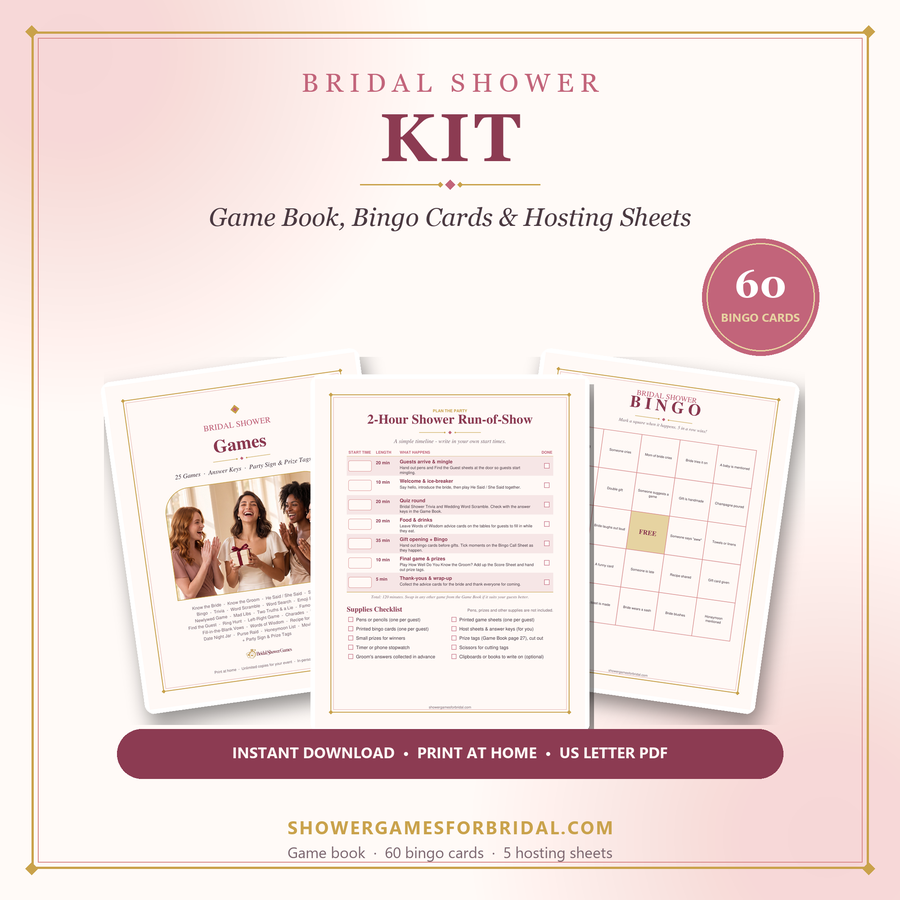
If you prefer designed paper activities, compare the paid packs below. Check each product page for its exact contents; not every browser activity has a matching printable.
For deeper planning help, see the guides on the main site: virtual & Zoom showers, funny games that aren't cheesy, games for large groups and co-ed & couples showers.