

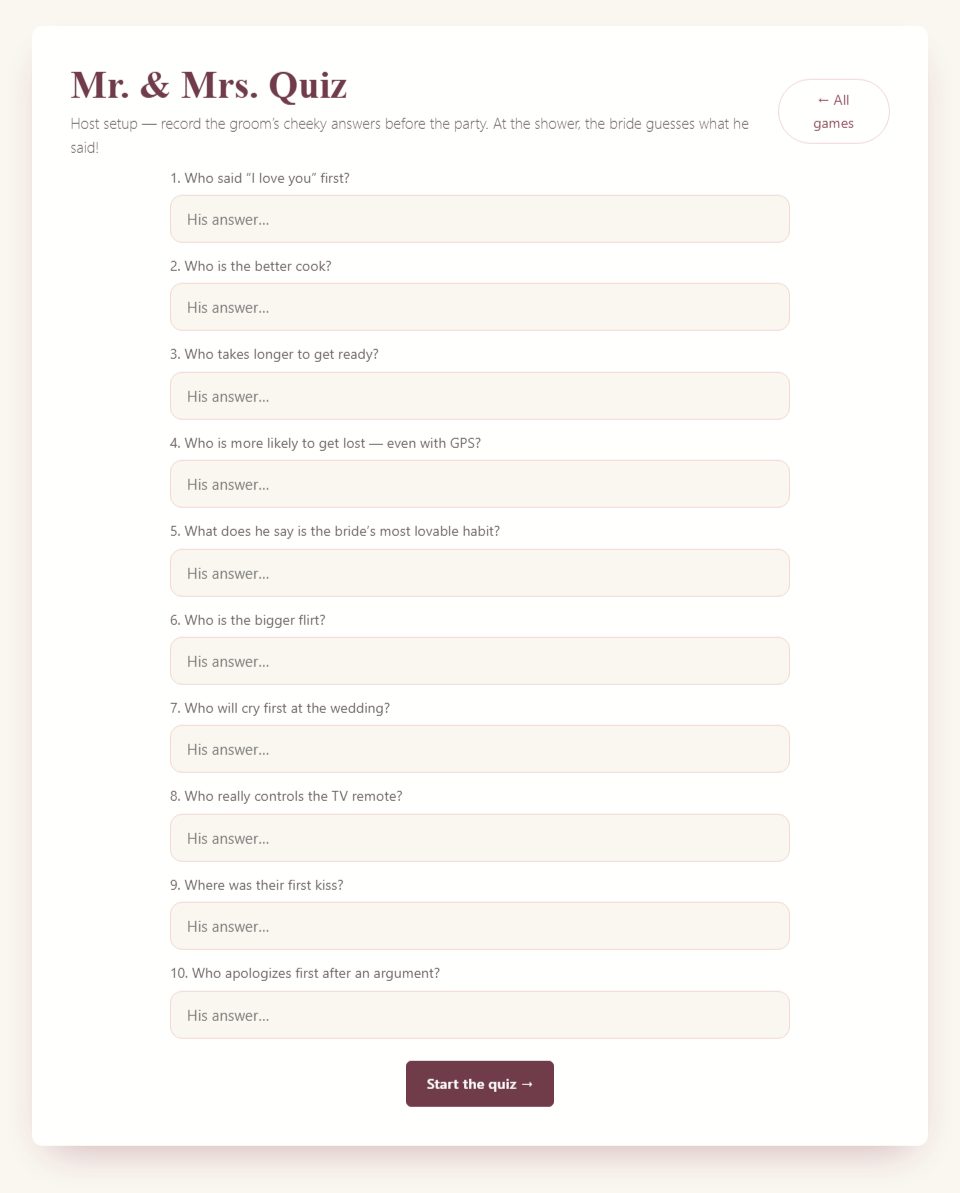
Record answers to ten fixed couple questions before the shower. The bride guesses aloud, and the host marks each answer as a match or miss.
How to play the browser version
Step 1
Ask the groom the setup questions privately and enter his answers. Leave unwanted questions blank; at least one answer is needed.
Step 2
Show each question and let the bride answer before revealing his saved response.
Step 3
After the reveal, tap She matched or Nope. This host decision records a match or miss and advances.
Step 4
The final score uses only questions with saved answers. Edit answers for another round or replay with the same key.

Host tips and optional variations
Decide whether equivalent wording counts. The app cannot judge a spoken answer or whether two phrases mean the same thing.
Prompts include who takes longer to get ready and where their first kiss happened. Omit topics the couple prefers to keep private.
For a guest competition, guests can predict match or miss on paper before the reveal. That extra score is separate from the browser tally.
Plan a matching conversation, not a relationship test
Mr. & Mrs. Quiz asks the bride to predict answers the groom supplied earlier. The browser presents ten fixed prompts, hides the entered answers and gives the host a match or miss choice after each reveal. The final count is therefore based on human decisions made during the round. The software does not listen to the bride, compare her words with the key or assess the couple’s relationship. Introduce it as a short party conversation with a score, not a measure of whether two people belong together.
Ask both partners whether they want this activity before making it a central part of the shower. The groom needs to know his answers will be shared, and the bride needs to know she will be invited to guess aloud. A surprise decoration is different from a surprise public quiz about private preferences. If either person would rather keep the format low-key, you can use fewer prompts, invite the room to guess together or choose another game. Their comfort matters more than completing a traditional format.
The title uses a particular couple format, but the useful idea is one person predicting another’s approved answers. If you adapt the roles, explain your version clearly while recognizing that the browser wording remains fixed. It does not have a setting that rewrites every label for a different relationship. A fully customized host-read version can use wording you prepare yourself. Do not promise interface options that are not present simply because the social game is adaptable.
Collect the answer key privately
Send the groom the exact ten questions shown in setup, along with a short explanation of the event. Ask him to answer only prompts he is comfortable sharing and to leave any unwanted one blank. A sample request is: “We are preparing the couple quiz for the shower. Your answers will be revealed after she guesses, so please keep them suitable for that group. You can skip any question, and I will confirm the final list before entering it.” This avoids hiding the intended audience from the person providing the answers.
Encourage concise answers without forcing every response into one word. A question about a first kiss may need a place name; a question about a lovable habit may need a short phrase. Long stories can be saved for a voluntary comment after the reveal. Clear text is easier for guests to read and for the host to compare. Do not rewrite a gentle response to make it sound sharper or more revealing. Preserve the meaning the groom approved, even if it produces a quieter moment.
If an answer is ambiguous, resolve that before the event. “Both of us” may be the most accurate response to a question framed as who does something first. Accept that as an answer rather than making him choose a person to create a more dramatic competition. Ask whether similar phrasing should count. The host can prepare a private note of acceptable equivalents, but the visible key should remain concise. This preparation prevents a debate about interpretation from replacing the intended reveal.
Review the prompts for this particular couple
Who said I love you first
This question may have a straightforward remembered answer or a story with more than one moment. Ask which moment the couple wants to use for the game. Do not assume the first spoken declaration, first message and first joking use of the phrase are interchangeable. If the answer is uncertain or private, omit it. A party quiz does not need to resolve a disagreement about relationship history. The key should be an agreed reference for a light round, not evidence in an argument.
Who is the better cook
Treat this as the groom’s chosen answer to a playful prompt, not an objective household assessment. He may say himself, the bride, both or a particular exception. If he says one person cooks everyday meals and the other makes desserts, decide whether to include the question with that fuller answer or skip it. Avoid attaching assumptions about gender or marriage duties. Guests are comparing a prediction with an approved response, not deciding who should do the cooking after the wedding.
Who takes longer to get ready
A specific context can make this answer easier to understand. Getting ready for work may differ from preparing for a formal event. Ask the groom what he means if the distinction matters, and note it in the host’s introduction without changing the underlying prompt. Do not turn the answer into criticism of someone’s appearance or routine. A brief reveal can be enjoyable without requiring the person named to defend the time they spend preparing.
Who is more likely to get lost
The prompt mentions getting lost even with navigation help. Keep the answer light and avoid adding real travel incidents the couple did not approve. A guest may remember a different trip, but that does not invalidate the recorded answer. The host can acknowledge that experiences differ and return to the key. If the question brings up an upsetting memory, it can be left blank. The app supports a shorter round by omitting unanswered fields.
The bride’s most lovable habit
Ask for a habit the groom is happy to describe warmly in front of the guests. This can provide a gentler moment among the comparative questions. The bride may predict the meaning without using identical words, so prepare a sensible match rule. “Leaving thoughtful notes” and “little notes in my bag” may express the same habit. Avoid demanding exact phrasing when the point is recognizing the behavior. If a word in the answer needs explanation, ask the groom before entering it.
Who is the bigger flirt
This question may suit some groups and not others. It should never become an invitation for guests to name other people, reveal messages or speculate about the couple. Ask for approval explicitly rather than assuming the word is harmless in every setting. If it does not fit, leave it out. A host does not lose the integrity of the quiz by removing a question. The final score will simply be based on the remaining answered prompts.
Who will cry first at the wedding
This is a prediction, not a fact that can be established at the shower. Guests are matching what the groom predicted. Explain that distinction if someone argues that the wedding has not happened yet. Either answer, both or neither can be his chosen response. Do not tease somebody for being emotional or present tears as a required sign of love. The prompt can be used lightly without turning a future emotional response into an obligation.
Who controls the television remote
The couple may not watch television together or use a remote in the way the question assumes. They can answer with their own understanding or omit it. Do not invent a routine to fit the wording. If they mainly choose programs on a laptop, the host can explain the question as who usually chooses what to watch, provided that meaning was agreed while collecting the key. The browser text remains fixed, so any clarification belongs in the spoken briefing.
Where their first kiss happened
Collect enough detail to identify the place without exposing a location they would prefer to keep private. A broad description may be sufficient. Decide whether a guest needs the venue name or whether “outside the café” counts. The bride’s answer may be more specific than the groom’s written phrase; that can still be a match. Avoid marking a correct location wrong merely because she recalls additional detail. The host’s job is to compare meaning consistently.
Who apologizes first
This prompt can sound more serious than intended if treated as a judgment about how the couple handles conflict. Ask whether they want it included. An answer such as “it depends” is legitimate if that is what the groom chooses, though it may make scoring less definite. You can omit it for a clearer round. Do not invite guests to offer unsolicited relationship advice in response to a mismatch. The activity is not a public discussion of how the couple should resolve disagreements.
Enter the answers and count the actual round
The setup has ten answer fields. Enter the approved responses and leave omitted questions blank. At least one answer is required to start. Only filled answers appear during play, so a game with seven completed fields is a seven-question round. Tell the bride and guests the actual number before beginning. Do not announce “out of ten” automatically if some prompts were intentionally excluded. The browser’s final denominator follows the answered items, which is the appropriate reference for the score.
Check the entered text against the original reply once, then test a reveal privately. Look for a response accidentally placed under the next question, an incomplete sentence or an answer that exposes more than intended. Keep a separate copy of the approved key. The browser saves the setup locally, and signed-in saving can support account backup, but a checked host copy remains useful if the event device changes or browser storage is cleared. Verify the playing device before guests arrive.
Avoid editing the key while the bride is answering unless correcting a genuine mistake that you explain openly. If an error affects fairness, treat the question as unscored in any separate competition. The app’s match buttons advance the round, so the host should understand the next action before tapping. A rehearsal with sample answers can show the sequence: question, reveal, match decision, next question. Keep practice separate from the actual saved key if you do not want to overwrite it.
Explain the host’s scoring responsibility
After a reveal, the host chooses She matched or Nope. Selecting a match adds one to the tally; either decision advances. The app cannot decide whether the bride’s spoken answer counts. Announce a simple rule such as accepting the same meaning rather than exact wording. If a question requires a particular detail, say so before the bride answers, based on the approved key. Do not reveal that requirement only after she gives a broader but reasonable response.
Use an invented example during the briefing. Suppose a saved answer says “a picnic by the river,” and the bride says “lunch beside the river.” Under a meaning-based rule, the host would normally mark a match. If she says “dinner at a restaurant,” it would not match that key. The example teaches the comparison without using one of the couple’s real answers. It also makes clear that the host, not speech recognition or hidden software logic, will make the decision.
If the bride gives two answers, decide how you handle that before play. You might ask for one final choice before revealing or accept a clearly stated combined answer when the key permits it. Avoid rewarding a long list of guesses simply because one eventually overlaps. A gentle prompt, “Which answer are you choosing for this question?” keeps the rule clear. There is no need for a harsh penalty or dramatic countdown unless the couple has specifically chosen that style of game.
Give the reveal room to breathe
Read the question, wait for the bride’s final answer and then tap Reveal his answer. Read the saved response aloud even if it is projected, so everyone can follow. Make the match decision after comparing the answers, not while guests are still calling out interpretations. A short pause for a comment can follow, but the couple should not feel they must produce a story after every reveal. Some answers will simply match, earn a point and lead to the next question.
A sample host sequence is: “Here is the next question. Take a moment, and tell us your final answer when you are ready. We will now see what he wrote. That has the same meaning, so I am marking a match.” For a miss, use equally neutral wording: “Those are different answers, so this one is a miss. Would either of you like to add a quick comment, or shall we continue?” This avoids making incorrect predictions sound like personal failures.
The host can keep the audience involved without letting it answer for the bride. Ask guests to hold their guesses until she commits, or invite them to write their own predictions privately. If a guest shouts an answer early, acknowledge the interruption and restate the rule. Do not punish the bride for hearing something she did not request. In a casual round, you can continue; in a stricter house competition, remove the question from the separate audience tally if it was compromised.
Add an audience layer only if you can manage it
Guests can predict whether the bride will match each answer before the reveal. Give them a simple numbered sheet with match and miss choices, and ask them to mark one before she answers or before the reveal, depending on your chosen rule. Keep that timing consistent. The browser does not collect these predictions, so audience scores need a separate tally. The couple’s displayed match count and a guest’s prediction score are different results and should be announced separately.
For a worked example, a guest predicts match on four questions and miss on two. If five of those six predictions agree with the host’s eventual decisions, that guest has five prediction points. The bride may have matched only three of the six answers. There is no contradiction: one score measures her matches, while the other measures predictions about those matches. Explain this distinction before using the extra layer, or skip it if the group would prefer listening without another score sheet.
Do not let the audience layer encourage guests to root for a mismatch. Frame it as predicting outcomes, not hoping the couple gets something wrong. Avoid betting language that makes the couple’s private knowledge feel like a spectacle. Physical prizes are optional. If the additional administration would distract from the conversation, use the simpler browser tally alone. More scoring systems do not automatically make the event more engaging.
Resolve disagreements with the couple’s comfort first
If the groom changes an answer after hearing the bride, the recorded key still explains what the browser round was set up to reveal. You can acknowledge the new thought without declaring that someone lied or failed. For a social game, the host can accept the clarification and move on; for an audience prediction contest, apply a transparent decision to everybody. Do not let an uncertain question consume more attention than the couple wants to give it.
If an answer is unexpectedly private, stop the discussion and skip ahead. Do not invite another guest to explain the background. A calm “We will leave that one there” is enough. The host should not prioritize preserving a perfect score record over protecting someone’s boundary. If the screen has already recorded a result, describe the final count as a light game result and avoid drawing conclusions from the affected question.
If the wrong match button is tapped, say what happened rather than pretending the displayed score is exact. Keep a manual correction if you need an accurate announced total, or restart only if the couple wants to and it will not spoil the reveals. The interface is a host-operated tool, so input mistakes are possible. Testing beforehand reduces them, but honesty about a mistake is better than building a false explanation around an accidental click.
Fit the quiz into the wider celebration
Place the activity when the couple and guests can hear each other without competing with food service or another announcement. A seated moment often suits a reveal quiz, but the exact place depends on the event. Do not schedule it as an unavoidable surprise immediately after someone arrives or before they have had a chance to settle. Tell the bride when it is coming so she can be ready and choose where she wants to sit.
The length depends on the number of filled answers and how much conversation follows. Ten prompts do not guarantee a fixed duration. If the schedule is short, prepare fewer approved answers rather than rushing the couple through every reveal. Keep a natural end point and move to the next part of the shower after the result. A replay with the same key is possible in the browser, but it is no longer an independent prediction round because the answers are known.
Close with a thoughtful acknowledgment
Read the final result as matches out of the actual number of questions. Avoid interpreting a high score as proof of compatibility or a low one as a warning. Thank the groom for providing answers and the bride for taking part. A warm closing might be, “That was our party quiz; thank you for sharing a few details with us.” The couple can add a comment if they want, but they should not have to reassure the room about a playful score.
Afterward, keep the answer key private unless the couple has agreed to share it. Check what remains saved on a communal device and keep a separate copy only for an intended purpose. If someone asks for a photograph of the answers, let the couple decide. The game’s public moment does not automatically turn its personal content into something for wider distribution. Ending with the same care used during preparation keeps the activity enjoyable beyond the final screen.
Frequently asked questions
Does a high score measure compatibility?
No. It counts matches to entered answers for a party quiz.
How does this differ from The Newlywed Game?
Mr. & Mrs. has ten fixed prompts and host-operated match buttons. The Newlywed Game has eight prompts and asks the host to tally matches separately.
Choosing paper games
The browser games and paid PDF packs are separate formats. A guide on this page does not mean the same game is included in a pack. Check the printable contents and page previews before buying; the packs are digital downloads that you print yourself.
 Save to Pinterest