

Agree on the tone before the party
Ask the guest of honor to rule out topics beforehand. Say “pass” is a complete answer. For Two Truths and a Lie, suggest everyday stories such as a travel mishap or an unusual hobby instead of secrets. Read submitted stories only with permission.
Game options to consider
Two Truths & a Lie
Enter two true statements and one invented statement. Guests vote before the answer is revealed. Only include stories the person wants to discuss.
▶ Play it free →“Drink If…”
Read a prompt and let guests decide whether it applies. A non-alcoholic drink or a show of hands can replace sipping, and any prompt can be skipped.
▶ Play it free →Bridal Shower Mad Libs
Collect the requested words before revealing the story, then invite a volunteer to read the result aloud.
▶ Play it free →He Said / She Said
The browser game uses fictional sample answers. For a round about your own couple, collect their answers separately and keep your own score.
▶ Play it free →Purse Raid
Read the items while guests check their own bags or pockets. Agree on scoring first and do not ask anyone to display private belongings.
▶ Play it free →Bridal Charades
Use the prompts for a timed acting round. Guests can volunteer to act, guess or keep score; nobody has to perform.
▶ Play it free →Wedding Emoji Pictionary
Guess the wedding phrase shown by the emoji. Collect answers before revealing so an early guess does not spoil the puzzle.
▶ Play it free →Mr. & Mrs. Quiz
Choose questions the couple is comfortable sharing, prepare the answers and compare them during the party. Either partner can skip a question.
▶ Play it free →Toilet Paper Wedding Dress
Give willing teams paper supplies and a short building period. Agree on judging categories first and ask permission before taking photos.
▶ Play it free →Choose the kind of funny your group enjoys
Some groups laugh most at an unexpected story. Others enjoy a ridiculous invented sentence, an awkwardly drawn clue or a familiar person making a harmless prediction. Start by asking the guest of honour which of those sounds enjoyable. A game can be funny without making anyone the target. If the group dislikes performing, choose a written puzzle or a story read by the host. If several people are eager to act, keep charades available after they volunteer. The best choice is the one that gives this group permission to be playful in a way they actually like.
Think about who will be in the room together. Close friends may share references that a cousin or colleague does not understand. A round built entirely around those references can leave part of the group watching a private joke. Mix familiar material with prompts everyone can interpret. The surprise should come from the answer or the combination of ideas, not from revealing a guest’s private history. Before the event, agree on subjects to leave out and keep a few neutral replacements ready. That preparation helps the host change direction smoothly if a prompt does not suit the moment.
Set the tone before the first joke
A short welcome can make the rules of participation clear: “We have a few silly rounds planned. You can guess, help a team or watch, and passing does not need an explanation. We are keeping the stories to things people have agreed to share.” This gives guests a useful expectation without turning the introduction into a long warning. Apply it yourself as host. If someone passes, move on warmly instead of asking why or encouraging the room to persuade them. An easy pass is only real when it does not create a second moment of attention.
Avoid promising that a game will make everyone laugh. People respond differently, and a quiet guest may still be enjoying it. Tell them what they will do instead: supply words, guess a story, act a prompt or compare an approved answer. Keep your own commentary brief enough that guests can react naturally. Explaining why a response is supposed to be funny rarely improves it. If a joke falls flat, reveal the answer and continue. The host does not need to rescue every moment with a more personal question or a louder performance.
Build a Mad Libs round around the reveal
For Mad Libs, collect the requested word types before showing the completed story. The hidden context is what allows an ordinary word to become an unexpected sentence. Explain a word type with a neutral example if someone asks, but do not reveal the sentence the word will fill. Ask different guests or tables for different contributions so one enthusiastic person does not supply everything. A mix of simple nouns, vivid adjectives and everyday actions can be more entertaining than trying to make every individual answer outrageous. The story creates the combination.
Invite a volunteer to read the result, or let the host do it. Read at a pace that leaves room for people to understand the sentence before the next one arrives. If the room laughs, pause rather than speaking over it. There is no need to rank the contributions or identify who supplied a word that produced a strange line. You can leave the activity unscored and enjoy the shared result. If the group wants another story, collect a fresh set of words before revealing it rather than letting guests rewrite the first result until the surprise disappears.
Choose truths that invite plausible guesses
Two Truths and a Lie works best when all three statements could reasonably be true. Ask the person preparing them to use similar lengths and levels of detail. “I once took a pottery class” beside a paragraph about a complicated holiday gives away differences in style before guests consider the story. Keep the subject matter light and approved. A surprising hobby, an unusual food preference or a harmless travel mix-up can provide enough uncertainty. There is no need to use romantic history, family conflict or information someone would be uncomfortable discussing after the answer is revealed.
Read all three statements before asking for votes. Give guests a short thinking pause, then collect A, B or C together. Reveal the invented statement and invite the person to add a little context if they want. Do not turn a correct guess into permission for cross-examination. If the true story is brief, let it stay brief. For a bridal-party gathering, one or two prepared sets can be enough to start conversation. Going around every person in sequence may take much longer, especially if each reveal becomes a story, so decide whether that fits the evening.
Make charades comfortable for willing performers
Ask for volunteers before assigning acting turns. A guest who prefers guessing can still be an active teammate, and someone else may enjoy keeping time. Explain the acting rules before the first turn. The browser starts a fixed sixty-second countdown as soon as “Show my prompt (60s)” reveals the prompt, so the actor should be ready first. Use prompts the group can reasonably recognise and preview references that may be unfamiliar. If a prompt is unsuitable for a performer, let them take another without a penalty or explanation. Keep enough clear space that the actor is not navigating chairs, drinks or decorations while trying to communicate an idea.
The browser does not provide a stealing phase. If you choose a separate manually hosted version that lets another team try, agree how and when that happens before the round. Keep the host’s role focused on time and clarity rather than commenting on someone’s physical performance. A funny interpretation can be enjoyed without comparing how graceful or confident people look. If volunteers are scarce, switch to a different game instead of repeatedly asking the room who is “brave enough.” The activity should reward willing participation, not make reluctance feel like a personal failing.

Let Purse Raid surprises stay voluntary
Purse Raid can reveal amusing everyday combinations: a spare button, an unexpected snack or several pens when nobody could find one earlier. Read the item list while guests check their own belongings. Decide on points before starting and explain whether pockets count. Keep the list appropriate to the group and the setting. Guests should not have to empty a bag, hand it to another person or display a private item to prove they are participating. A simple acknowledgement can be enough for an informal round, and passing should remain an ordinary option.
The host can enjoy an unexpected find without inventing a story about its owner. “Someone came prepared” is different from suggesting why a personal object might be there. Avoid calling for sensitive items or turning the game into a search through someone’s phone, wallet or medication. If guests do not carry bags, offer a different short activity rather than making them compete at a disadvantage. You can also run the round in teams, with each person choosing what to contribute. Keep the focus on the playful list, not on inspecting people’s possessions.
Use couple quizzes without turning them into a roast
A couple quiz can produce funny differences in answers, but those differences do not need a judgement from the host. A preference mismatch might lead to a short story about two very different ideas of a holiday. Let the couple decide whether to explain. Avoid comments suggesting that one partner should have known better or that a score predicts married life. The game asks a small set of questions under party conditions; it does not measure a relationship. Agree on topics and passes beforehand so the couple can enjoy the reveal without anticipating an unwanted surprise.
Use the correct preparation for the chosen browser game. Mr. & Mrs. has ten fixed prompts with host-marked matches. The He Said / She Said browser activity uses fictional sample answers, so it cannot be presented as a personalised account of your couple without a separate approved key and manual hosting arrangement. If you want custom questions, prepare a paper version. Tell guests whose submitted answer they are matching and what equivalent wording counts. Clear rules prevent an amusing response from becoming an argument over whether the host has changed the answer after hearing the room.
Keep a paper-dress challenge playful and practical
For a toilet-paper dress activity, ask who would like to build and who, if anyone, would like to model. Modelling is optional; a team can use another agreed display method if the available materials and space allow it. Give teams the same basic supplies and a clear building period. Choose judging categories before the start, such as a creative detail or a memorable team description, rather than judging a person’s body or appearance. Keep the materials loose enough that participants can move comfortably and leave the activity whenever they want.
Allow time for the reveal and cleanup as well as construction. Ask permission before taking photographs, especially of someone modelling the result. A short description from each team can be fun, but do not require every builder to speak. Keep scraps away from walkways and food. If the venue is crowded or the schedule is tight, this may be a poor choice for the moment even if the group likes the idea. A written or story game can provide a similar playful break with less setup. Choose according to the actual space, not only the photographs you imagine afterwards.
Offer a non-drinking way to join Drink If
When a Drink If prompt is read, guests can decide privately whether it applies and whether they want to respond. A non-alcoholic drink or an agreed show of hands can replace sipping. Do not require anyone to explain their drink choice or why they skipped a prompt. The activity should not depend on escalating how much people consume. Keep the tone and selected prompts appropriate for the group, and make participation optional. If the gathering would be more comfortable without a drinking format, choose another game from the list rather than trying to persuade people to accept it.
A host can introduce the alternative clearly: “We are using a show of hands for this round, and you can pass on any prompt.” Then follow that format consistently. Avoid asking guests to identify who did not respond or to provide evidence for a story. If a prompt starts a conversation, invite voluntary comments and move on when the person is finished. The humour can come from recognising an ordinary experience shared by several guests. It does not need a confession, a penalty or a rule that draws attention to someone who prefers to remain quiet.
Use a visual puzzle between story-heavy rounds
After a personal story game, an emoji puzzle can give the group a different kind of task. Display one prompt clearly and collect guesses before revealing the answer. Guests can write individually or discuss at their table. Read any answer choices aloud so people are not relying only on a distant screen. Keep separate guest or team totals if you want scores; a single shared browser selection does not record every response. The host can choose a short set and announce the last prompt rather than continuing until the group loses interest.
Check whether the symbols are readable from the back of the room or inside a phone-sized video-call window. If not, enlarge the view or choose a nonvisual activity. A puzzled reaction can be funny, but do not tease someone for interpreting an emoji differently. Reveal the intended answer and let the group move on. For a casual gathering, you may decide that entertaining guesses are part of the enjoyment even when they earn no point. Keep that distinction clear so the scoring remains consistent while the conversation stays open.
A three-round example with different energy levels
One possible sequence is a short Mad Libs story, a prepared Two Truths and a Lie set, and optional charades after a break. The first lets everyone contribute small pieces, the second invites guessing and conversation, and the third gives willing performers a chance to act. You do not need to use all three. Mark charades as optional and decide after the earlier rounds whether the group wants it. Keep the props and prompts ready but out of view until then. This lets the gathering develop naturally without asking guests to commit to a long programme at the start.
Allow a pause between activities for drinks, food and ordinary conversation. Announce each new format in a sentence before explaining its rules. If one story becomes the highlight of the evening, skip a later round rather than cutting it short to finish the list. The times should reflect your actual group and the number of turns, not a promise that every game lasts the same amount. For a larger gathering, use teams or simultaneous responses so most people are not waiting through a long series of individual performances.
Use host reactions that keep the room comfortable
The host can acknowledge a funny answer without adding a more personal joke. Repeat the answer clearly if people at the back missed it, then give the room a moment to react. Avoid explaining the guest’s motive or attaching an embarrassing interpretation they did not offer. If laughter turns towards a person rather than the game, redirect gently to the next prompt. A simple transition such as “Let’s see what the next team chose” can change the focus without making the moment larger. Keep your attention on whether the person involved is comfortable.
If someone shares a story that goes beyond the agreed tone, do not invite more detail just because other guests are curious. Thank them and move to a neutral prompt. If a participant appears uncomfortable, offer a break or another role without demanding a public explanation. You can also stop a round early. The host is allowed to adapt the plan when it is no longer serving the gathering. Having a few ordinary backup prompts prepared makes that easier because you do not need to improvise a new direction while everyone is watching.
Choose prizes without making humour a popularity contest
A quiz can use points, but “funniest guest” is a more subjective label. If you want prizes for a creative game, announce several specific categories beforehand and keep them light. You might recognise a surprising word combination or a clear charades clue, provided the categories fit the activity. Avoid judging people’s bodies, relationships or willingness to reveal private information. You can also leave the creative rounds unscored and reserve a small prize for a separate factual puzzle. That lets guests enjoy an odd story without wondering whether the room found them personally entertaining enough.
Prepare for ties and team wins. A prize intended for one person may be awkward if six people contributed to the result. Decide whether the recognition is shared, whether there are small items for each teammate or whether the game simply ends with applause. State the method before play. Do not introduce a surprise performance as a tie-breaker when the original activity did not require acting. The result should feel like a pleasant ending, not another test someone must pass before they can return to the party.
Ask before turning a funny moment into a keepsake
A funny answer may be welcome in the room without being something the speaker wants posted online. Ask before photographing a completed story, a dress model or a couple’s answer board. Check whether names or private notes appear in the image. For a small keepsake, the group can offer the couple an approved Mad Libs story or a short collection of wishes. Keep personal preparation material separate. Do not assume that permission to play a game includes permission to distribute every response to people who were not invited.
If the couple wants to save a result from a browser activity, check the actual save or copy function before promising how it will be delivered. Copying text does not send an email, and entries made on separate devices do not automatically become one shared collection unless the chosen feature supports that flow. A paper copy or a host-prepared document may be simpler for a keepsake. Confirm what has been saved and where, then hand it over in the agreed way. The moment can remain enjoyable without being recorded at all.
Finish while the group still has room to talk
Tell guests when the final prompt is coming and keep that promise. A funny round often leaves people with stories they want to share in smaller conversations, so leave time for that. Thank the volunteers, the people who prepared answers and anyone who helped with materials. You do not need to recap every joke or persuade the group to replay a round that has reached a natural ending. If guests ask for another activity, use a prepared option and explain its scope before beginning. Otherwise, let the celebration continue without another set of rules.
Afterwards, note which formats suited the group rather than ranking the guests’ reactions. Were the prompts easy to understand? Did people have comfortable ways to pass? Was the display readable, and did the host leave enough time for the reveals? Those are practical questions you can use for a future party. The aim is a gathering where people can laugh together without being cornered into sharing or performing. A modest selection of well-prepared games, with clear boundaries and a flexible host, gives that kind of humour room to happen naturally.
Optional paid printable packs
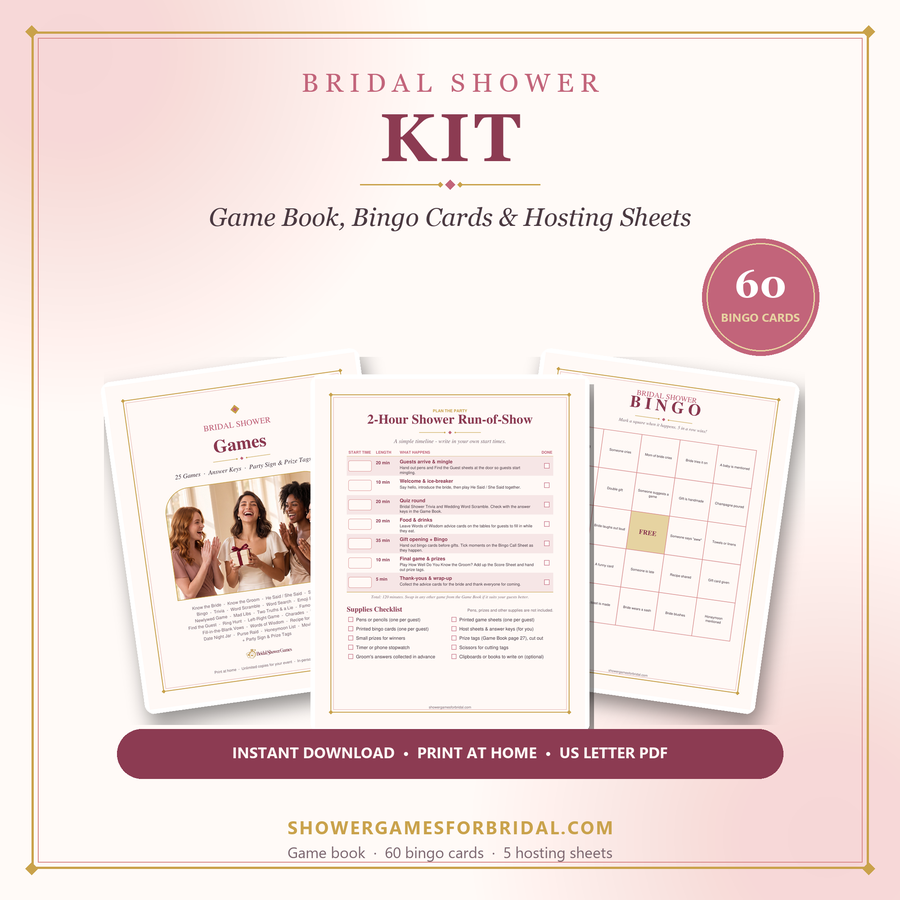
If you prefer designed paper activities, compare the paid packs below. Check each product page for its exact contents; not every browser activity has a matching printable.
For deeper planning help, see the guides on the main site: virtual & Zoom showers, funny games that aren't cheesy, games for large groups and co-ed & couples showers.