

Explain the activity without a sales pitch
Try: “There is a short puzzle on your table if you would like to try it. We will go through the answers after food.” Or: “Write a wish for the couple whenever you have a moment.” Avoid announcing that everyone must play or that a reluctant guest will enjoy it once they start.
Game options to consider
Wedding Word Search
Find ten words in an untimed browser puzzle. Play alone or cooperate with a neighbour; there is no leaderboard.
▶ Play it free →Mr. & Mrs. Quiz
Choose questions the couple is comfortable sharing, prepare the answers and compare them during the party. Either partner can skip a question.
▶ Play it free →Bridal Shower Mad Libs
Collect the requested words before revealing the story, then invite a volunteer to read the result aloud.
▶ Play it free →Wedding Emoji Pictionary
Guess the wedding phrase shown by the emoji. Collect answers before revealing so an early guess does not spoil the puzzle.
▶ Play it free →Bridal Trivia
Try a short selection of multiple-choice wedding questions. Cooperate on one browser score or keep guest totals separately.
▶ Play it free →Purse Raid
Read the items while guests check their own bags or pockets. Agree on scoring first and do not ask anyone to display private belongings.
▶ Play it free →Marriage Advice Cards
Leave an optional message for the couple. Use one shared collection device or a separate paper station; guest devices do not automatically merge entries.
▶ Play it free →Name That Love Song
Choose a title from written clues. There is no audio playback and nobody needs to sing.
▶ Play it free →Name what you want to avoid before choosing a game
“Not cheesy” means different things to different hosts. You might dislike forced introductions, embarrassing questions, costume-building, competitive shouting or a long programme that interrupts conversation. Write down the actual things you want to avoid. That produces a more useful plan than searching for a game guaranteed to please everyone. If the concern is performing in front of strangers, choose a written activity. If it is personal questions, use a general puzzle. If it is too much structure, offer an optional table activity and leave most of the gathering open.
Ask the guest of honour which parts of past parties they enjoyed and which they would prefer to skip. You do not need a detailed critique of anyone else’s event. A simple preference such as “one short game after lunch, with no spotlight questions” is enough to guide the choice. Keep that preference visible while planning. It is easy to add more activities because they are available, but availability is not a reason to use them. A relaxed shower can have one game, several optional stations or no formal game block, depending on the couple’s wishes.
Invite participation without trying to sell the activity
Use a straightforward introduction that tells guests what is available. “There is a word puzzle on the table if you would like to try it; we will show the answers after food” is clear and low-pressure. Avoid telling reluctant guests that they will enjoy it once they start. They may prefer conversation, watching or simply being present. If you say participation is optional, do not collect names of people who have not played or ask them to explain a blank sheet. The host’s behaviour should match the invitation.
For a shared round, explain the scope: “We are doing six questions, then returning to conversation.” Keep that stopping point. Guests are more likely to settle into an activity when they understand its length and what it asks of them. A dramatic introduction can make a simple puzzle feel like a performance obligation. You can sound warm without promising nonstop laughter or a battle to discover the best friend. Let the actual activity provide the interest, and give people an easy way to join at the level that feels comfortable.
Choose an untimed puzzle when you want a quiet option
A word search lets guests look for answers at their own pace, either individually or with a neighbour. The browser Wedding Word Search has ten words and no timer. It is a different experience from the sixty-second Word Scramble round, so choose deliberately. If the gathering should feel unhurried, do not add a surprise race to an untimed activity. Guests can enjoy finding a few words without needing to finish the whole grid. Tell them whether you will reveal anything together later or simply leave the puzzle available.
For a paper version, use material you have prepared or a printable whose contents you have checked. Do not assume the browser page automatically has an identical designed PDF. If guests share a device, let them agree on selections rather than turning it into a queue of individual attempts. A quiet puzzle works best when people can pause for conversation and return without losing the group’s place. Keep pens or the device within easy reach, and avoid placing the activity where it blocks food or requires guests to move away from comfortable seating.
Host a short general quiz without ranking friendships
A general wedding trivia round can give guests something shared to think about without asking them to know private details of the couple’s lives. Preview the questions and select a small set appropriate to the group. Use one shared display so everyone sees the same prompt at the same time. Guests can answer on paper, discuss at a table or cooperate on one browser selection. The last option needs no separate team score because the group is intentionally choosing one answer together. For individual or table competition, keep those totals outside the host’s browser score.
Keep the commentary about the questions rather than the people who miss them. There is no need to announce who should have known an answer or to describe a score as a test of wedding expertise. If a prompt is unclear to the room, reveal it and move on. You can end with the shared result instead of a prize. A short quiz can be satisfying simply because it gives people a reason to compare guesses. It does not need elaborate team names, penalties or a tie-breaking performance to justify its place in the afternoon.
Use personal questions only when the couple wants them
For some couples, a few approved preference questions feel personal in a pleasant way. For others, being watched while answering feels uncomfortable. Ask before making them the centre of a quiz. If they agree, collect the questions and answers in advance, identify what may be read aloud and leave out anything they do not want discussed. Ordinary topics such as food, hobbies or a favourite day out can be enough. The activity does not need a surprising secret to feel connected to the people being celebrated.
When using Mr. & Mrs., preview its ten fixed prompts and host-marked match format. If you want different wording, prepare a separate paper round. Explain whose answer guests are matching and accept equivalent wording consistently. If the couple disagrees or changes an answer, do not use that as an opening for teasing about their relationship. You can remove the question from the score or leave the round unscored from the start. The purpose is to hear a few things they are happy to share, not to make them prove anything in front of the room.

Offer a message station that does not demand public reading
A small message station can provide an optional activity without interrupting the group. Put a clear prompt beside cards and pens, such as an invitation to write a wish for the couple or suggest an ordinary activity they might enjoy together. Explain whether the messages will be read at the event or given to the couple privately. Do not surprise guests by reading a note aloud when they expected a private keepsake. Keep the station somewhere accessible, with enough room to write without holding up a queue.
If you use the browser advice collection, plan how entries reach one collection. Passing one host device is different from asking each guest to type on a separate phone; separate lists do not automatically merge into a communal guestbook. A copy function copies text to the clipboard rather than sending it by email. Test the actual workflow before promising a finished keepsake. Paper can be simpler if the group prefers it. In either format, mention the station once and let guests decide whether and when to contribute, without checking who has completed a message.
Use Mad Libs as a shared creation rather than a contest
Mad Libs can suit a relaxed gathering when guests contribute a few words and the host handles the reading. Explain the requested word types with neutral examples, collect contributions before revealing the story and invite a volunteer to read the finished result. Nobody needs to act out the story or defend the word they supplied. You can leave it unscored. The pleasure comes from seeing how ordinary contributions combine, so there is no need to tell guests to produce the wildest or most embarrassing word they can imagine.
Keep the tone appropriate to the guest list by giving a simple brief before collecting words. If the couple wants a family-friendly story, say so. Avoid editing someone’s contribution publicly because it is not funny enough. If a word does not fit the requested type, explain the type again and let them choose another. One completed story may be enough for the moment. If guests enjoy it and want another, collect a fresh set; otherwise, let the result become a conversation rather than repeating the activity until it loses its lightness.
Use written music clues without asking anyone to sing
Name That Love Song uses written clues and answer choices; it does not play audio. That can be useful when you want a music-themed puzzle without arranging speakers or asking guests to perform. Preview the references to see whether they suit the group. Read the clue and collect guesses before selecting an answer on the host screen. If several tables are playing, record their results separately. Do not invite a guest to sing simply because they recognised the title unless they volunteer to do so.
A written clue round can be paired with ordinary background music before or after the game, but keep those activities distinct. Lower any music while explaining the rules so guests can hear. If the group does not share enough of the references, choose a different puzzle rather than insisting that everyone should know the songs. You can also play cooperatively and let guests help one another. The round then becomes a conversation about familiar titles rather than a competition over cultural knowledge. Keep the number of clues modest so people can return to the rest of the gathering.
Arrange the room so a game is easy to ignore or join
For an optional activity, place materials where guests can notice them without feeling watched. A small sign with one sentence of instructions is enough. Keep the food area and main conversation seating usable. If a guest has to stand in a queue or ask the host for permission to take a sheet, the activity becomes more formal than intended. Give people a place to leave a finished page if it will be checked later, and explain whether a name is needed. Anonymous messages or unscored puzzles may not need one.
For the one shared round, make sure the display is readable and everyone can hear before beginning. A calm tone does not help if guests are straining to follow small text. Read prompts aloud and allow a repeat. Keep aisles clear and let seated guests participate without moving. If you use table teams, choose one writer but allow discussion so the most confident voice does not take every answer. The room arrangement should support the kind of interaction you want: a little shared focus, then an easy return to conversation.
A relaxed afternoon example with one formal game
Imagine guests arriving to food, drinks and an optional word puzzle. The host welcomes everyone and says the answers will be available later. After people have eaten, the group plays one short shared quiz with an announced number of questions. The host reveals answers, thanks everyone and returns the room to conversation. A message station remains available for anyone who wants to write a wish. Gifts, speeches or another planned part of the shower can follow according to the couple’s preferences. This is an example structure, not a schedule every event needs to copy.
The plan has one clear moment when everyone is invited to focus together, while the other activities are optional. It does not need a second formal round unless the group asks for one and the couple wants it. Keep an extra puzzle ready as a choice, not as an obligation. If conversation is flowing before the shared quiz, you can delay it or shorten the selected set. Tell your helper about the change so they do not begin distributing another activity. A relaxed event still benefits from coordination; it simply uses that preparation to make fewer interruptions.
Treat reluctance as an ordinary preference
If a guest says they do not enjoy games, accept that without trying to find a contradiction. They can watch, keep talking quietly elsewhere if the room allows it, or help only if they want to. Do not assign them scorekeeping as a disguised requirement to participate. A host can say, “Of course—join in if you feel like it.” Then continue with the guests who are interested. Making room for that choice often keeps the atmosphere more comfortable than spending several minutes persuading one person while everyone else waits.
If many guests seem uninterested, consider whether the timing or activity is wrong for the moment. Food may have arrived, the room may be noisy or people may simply prefer conversation. You can stop at the next natural ending. Avoid telling the room it needs more energy or blaming them for not responding as expected. The event is for the people attending, and the plan can adapt. Keep your ending warm and specific: “We will leave the rest of the puzzle on the table and move on to lunch.”
Keep prizes optional and the result modest
A game does not need a purchase or prize to count as an activity. For a relaxed quiz, you can announce the result and congratulate the group without handing out anything. If you want prizes, choose a simple rule and explain ties beforehand. Avoid making the final result a long ceremony when the game itself was short. For creative activities, consider leaving them unscored rather than asking guests to vote for the funniest friend. That keeps the focus on the shared result and avoids turning an optional contribution into a popularity contest.
If a paid printable helps with preparation, check its exact contents and preview pages. Browser activities remain free, and a larger pack does not mean you should schedule every included game. You can select one page that fits the event and leave the rest unused. For a plain question sheet or message prompt, your own document may be enough. Spend according to the preparation you want to save, not because a relaxed shower needs a particular product to look complete. Clear instructions and a readable layout matter more than the number of activities purchased.
Keep a quiet backup for technical problems
If a screen-based activity fails, a paper puzzle or an approved spoken question can provide a simple alternative. Prepare it beforehand rather than assuming every browser game works offline. Keep the backup instructions short and tell guests whether any earlier scores are being kept. You can also choose to skip the game entirely. A technical delay does not create a need to fill the same time with a more elaborate activity. Returning to conversation may fit the intended atmosphere better than troubleshooting in front of everyone.
Test the selected game once on the actual device and display before the party. Check the first prompt, the reveal and the ending so you know the whole sequence. If personal answers are stored, verify that the correct version is visible on the hosting device. Keep a separate approved key where appropriate. This preparation supports a calm event because the host is not trying to learn controls while guests wait. The backup is there for the remaining uncertainty, not as a replacement for checking the primary plan.
For example, suppose the host planned a six-question screen quiz after lunch, but the display will not connect. A prepared envelope can contain the same approved questions on plain paper, one key and spare pens. The host reads them aloud, guests write their guesses and everyone marks against the key afterwards. If you have not prepared those questions separately, use a different paper activity that is ready rather than trying to reconstruct a shuffled browser round from memory. Tell guests which round counts before they begin.
If lunch itself runs late, the better adjustment may be to leave the optional puzzle on the tables and skip the shared quiz. Let the helper know before they distribute answer sheets. Then use a simple transition into the next planned moment, such as messages for the couple. This keeps the change coherent: guests are not holding unused papers or wondering whether they missed instructions. A small backup note should state both options, so another host can make the same practical decision if you are busy elsewhere.
End with the couple rather than the score sheet
When the shared activity finishes, thank the couple for any answers they supplied and thank guests for joining in. Move clearly to the next part of the gathering. If messages were collected, give them to the couple in the way you agreed, without reading private notes aloud or displaying every response. Ask before sharing photos of completed sheets. A small keepsake can be meaningful without becoming a public performance. Some couples may prefer to keep nothing beyond the memory of the afternoon, and that is a reasonable choice too.
Afterwards, assess the plan by whether it suited the people, not by whether every guest laughed or completed a page. Were the instructions easy to follow? Was opting out comfortable? Did the game leave enough room for food and conversation? Those answers can guide a future gathering. “Not cheesy” is not a special category of activity with a guaranteed reaction. It is a practical fit between the couple’s preferences, the guest list and the way the host introduces and runs the game.
Optional paid printable packs
If you prefer designed paper activities, compare the paid packs below. Check each product page for its exact contents; not every browser activity has a matching printable.
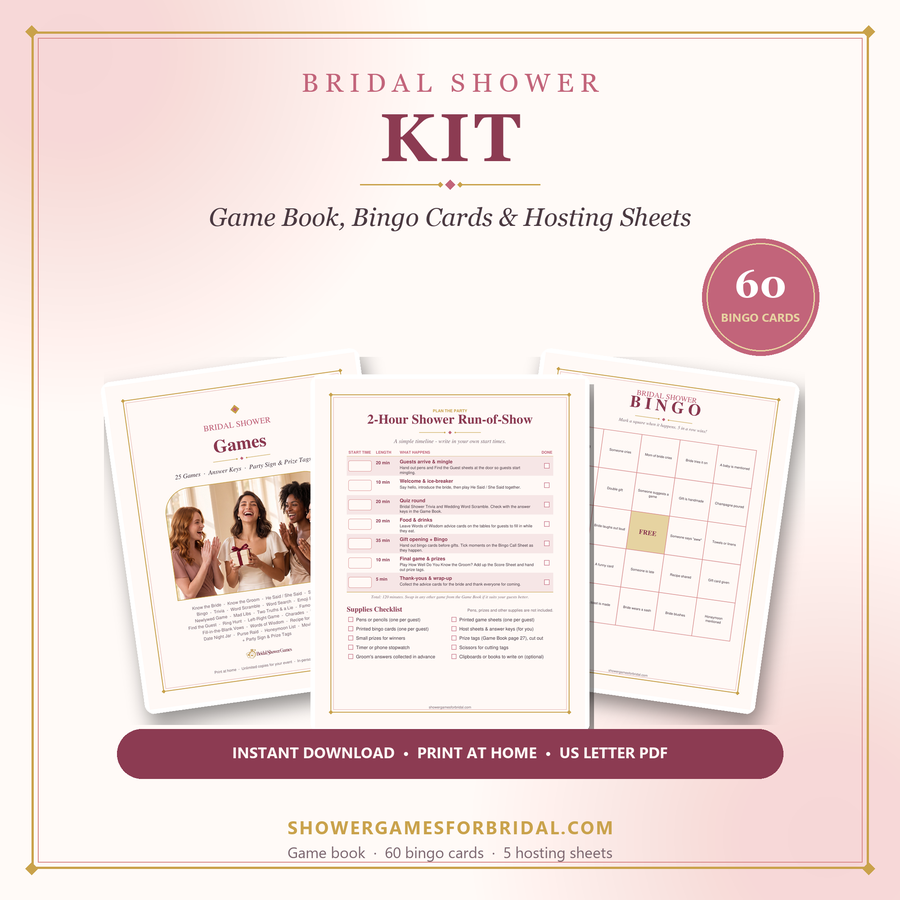
For deeper planning help, see the guides on the main site: virtual & Zoom showers, funny games that aren't cheesy, games for large groups and co-ed & couples showers.
Keep reading
More questions hosts ask
What are good non-cheesy games for a bridal shower?
Choose games built on real knowledge or conversation rather than costumes or forced performances: a bride quiz with answers she approved, a love-story timeline, advice cards or team trivia. Guests join in willingly when nobody has to stand up alone or wear anything.
How can you adapt classic bridal games to be less cheesy?
Keep the mechanics and change the delivery. Play the toilet-paper dress as a quick team design challenge judged by the bride, turn He Said/She Said into a team quiz, and let guests pass on any prompt. Shorter rounds and small, useful prizes also make classics feel less forced.