

Choose by the source of the joke
For an unexpected story, collect words before showing the Mad Libs text. For a couples reveal, prepare answers and agree which can be shared. For an acting round, ask for volunteers and offer guessing or scorekeeping roles. A funny wrong answer can be shared by its owner; it does not need to become a public correction.
Game options to consider
“Drink If…”
Read a prompt and let guests decide whether it applies. A non-alcoholic drink or a show of hands can replace sipping, and any prompt can be skipped.
▶ Play it free →Mr. & Mrs. Quiz
Choose questions the couple is comfortable sharing, prepare the answers and compare them during the party. Either partner can skip a question.
▶ Play it free →Toilet Paper Wedding Dress
Give willing teams paper supplies and a short building period. Agree on judging categories first and ask permission before taking photos.
▶ Play it free →Bridal Charades
Use the prompts for a timed acting round. Guests can volunteer to act, guess or keep score; nobody has to perform.
▶ Play it free →He Said / She Said
The browser game uses fictional sample answers. For a round about your own couple, collect their answers separately and keep your own score.
▶ Play it free →Wedding Emoji Pictionary
Guess the wedding phrase shown by the emoji. Collect answers before revealing so an early guess does not spoil the puzzle.
▶ Play it free →Purse Raid
Read the items while guests check their own bags or pockets. Agree on scoring first and do not ask anyone to display private belongings.
▶ Play it free →Bridal Shower Mad Libs
Collect the requested words before revealing the story, then invite a volunteer to read the result aloud.
▶ Play it free →Choose the kind of reveal your guests will enjoy
There is no single funniest bridal shower game for every group. A story assembled from unexpected words creates a different reaction from an approved couple answer or a dramatic charades gesture. Start by choosing the kind of reveal you want. Do guests enjoy making something together, guessing a preference or watching a willing performer? That decision gives the host a useful direction without promising a particular volume of laughter or treating a quiet response as failure.
The reveal should be understandable. If a joke depends on a private history known by two people, the rest of the room may feel excluded. If the host explains a joke for several minutes, it can take over the activity. Choose prompts with a clear setup and let a personal detail add to it when the couple approves. An imagined suitcase that will not close is easy to picture; a vague reference to “that trip” may not be.
Keep the source of the surprise separate from the person’s dignity. A mismatched guess can be funny because it differs from the key, not because the guest is supposedly foolish. A paper outfit can be funny because of a giant decorative choice, not because of the model’s body. The host’s introduction and reaction shape that distinction. Describe what happened in the game rather than labeling the person who made it happen.
Use word combinations for a shared surprise
A fill-in story creates a reveal nobody fully controls. Guests supply words before seeing the sentence structure, and the completed text puts those words into an unexpected context. Bridal Shower Mad Libs uses ten input fields and one of three story templates. The host should keep the story hidden while collecting answers. If everyone sees the finished sentence first, they may choose tidy words that fit it, producing a different and less surprising exercise.
Ask different people for contributions. One guest can give an adjective, another an animal and another a place. Explain the word type when needed without turning the explanation into a grammar test. A host can say, “Give us a describing word, such as shiny or sleepy, but choose your own.” That provides a usable example while leaving the creative decision with the guest. The activity is easier to join when nobody feels embarrassed for asking what a plural noun means.
Invite a volunteer to read the result. A calm reading can work just as well as a dramatic one, depending on the group. Do not insist that the reader imitate a person or use an accent for a reaction. The words already provide the contrast. If a phrase is worth keeping, copy it manually before starting a new story; the browser does not offer a saved-story collection or designed PDF export. A good first result does not require several replays of the same small template pool.
Build a couple reveal around an approved answer
For a personal quiz, the surprise comes from comparing guests’ guesses with an answer the couple supplied. Ask permission for the questions and the intended audience before entering the key. A prompt about a favorite snack or dream date can be light without requiring intimate detail. Keep the answer stable for the round. If a partner changes their mind after hearing the guesses, acknowledge that preferences can change while explaining what the recorded key was.
A sample host-prepared question might ask who would pack extra snacks for a short trip. Guests choose Partner A, Partner B or Both, then the host reveals the couple’s agreed response. The funny part may be an approved detail about the kind of snack, but that extra detail does not have to be scored. Distinguish the answer used for points from the conversation afterward. This lets the reveal remain fair while giving the couple room to add what they want.
The browser He Said / She Said key is fictional. It should not be presented as a reveal about the actual couple or as an answer chosen by research. For a real-couple version, prepare a separate key and manual tally. Mr. & Mrs. Quiz and other custom-answer reveal games have their own fixed prompts and controls. Choose the one that matches your intended activity rather than implying every game can accept your custom question list.
Let physical interpretation create the joke
Charades gives an actor a clear idea and asks them to communicate it without the usual words. A wedding action such as cutting an enormous cake can produce an exaggerated gesture that the room understands. The browser provides prompts and a sixty-second turn, while a person marks correct guesses. It does not inspect the performance or know whether a spoken answer should count. Agree on sounds, props and equivalent answers before starting.
A willing actor can make a simple prompt distinctive through scale, pace or expression. They do not need to be a confident performer or tell a personal story. Let guests choose guessing or operating roles if they prefer. The host should avoid assigning a prompt because it resembles somebody’s body, job or private experience. A neutral action leaves the creativity with the actor and reduces the chance that the room laughs at an unwanted personal comparison.
For a paper-based variation, the host can ask volunteers to act the same simple idea in different styles, such as very slowly or as though carrying something fragile. These are prepared house instructions, not browser settings. Keep the task comfortable and avoid requiring movement that is unsafe in the space. The result can be playful without running, climbing or handling real breakable objects. A clear imagined situation is enough.

Use a creative build when the reveal needs a visual result
A paper-dress challenge produces a visible object that teams can show after a set time. The enjoyment can come from an ambitious design meeting a difficult material, but the model should remain comfortable and willing. Give equal supplies and explain the judging categories before building. The browser’s judging screen uses creativity, elegance and structure, with numbers entered by a person. It does not automatically score photographs or decide which team worked hardest.
Ask each team to explain one design choice rather than deliver a long invented sales pitch. A large paper bow or folded train can have a short name and a reason. That gives the reveal a beginning and end. Avoid comments about how the model looks outside the activity. The judge should discuss the construction, overall design and whether it holds under the agreed presentation conditions. A stationary turn is enough if the model does not want to walk.
The full activity includes briefing, building, presentation, judging and cleanup. A ten-minute default timer covers only the build. If the schedule cannot support the rest, choose a smaller host-prepared accessory challenge or a different game. Rushing the reveal after teams spent time creating something can feel less enjoyable than giving a simpler task a proper finish. The host should plan the moment the audience sees the result, not only the period when teams are busy making it.
Make wrong guesses a voluntary source of conversation
Emoji puzzles can produce plausible interpretations that differ from the fixed key. If a guest wants to explain their reasoning, invite a brief comment after the answer is shown. The host does not need to identify every wrong response or read a private sheet aloud. A guess can be incorrect without becoming public entertainment. Ask, “Did anyone have another interpretation they want to share?” rather than choosing a person whose answer you found amusing.
Wedding Emoji Pictionary uses four choices and one score on the playing device. A table competition needs a separate host tally. The deck is shuffled, not ordered from easy to difficult. Do not tell the room that they missed an obvious beginner question just because it appeared early. A predefined answer can be accepted for the game while acknowledging that emoji are open to interpretation. That honesty makes a discussion easier than pretending every clue has only one imaginable meaning.
For a host-created extra round, guests can draw or type their own emoji clues on paper or in a chosen chat. This is not a custom editor inside the browser game. Ask the creator to prepare an intended answer and offer a clue if the group is stuck. Avoid scoring ambiguity too strictly in a creative round; the goal may be sharing how the clue was constructed rather than ranking who interpreted it fastest.
Choose personal-prompt games with care
Drink If can create recognition when several guests relate to the same statement, but it does not require alcohol or disclosure. A raised hand, a nonalcoholic drink or passing can all be part of the host’s format. Do not count how many cards apply to each guest and call that a friendship score. The browser has no winner. The host can invite an optional story and then move on without asking people to prove that a card applies to them.
Truth or Dare needs a clear pass option. Some cards involve performance, photographs or contacting someone, so preview them and consider the people affected. A guest should not receive an extra penalty because they do not want to act, answer or send a message. Use the next-player flow to continue. If the deck’s tone does not suit the gathering, choose another activity instead of treating discomfort as evidence that the game is becoming exciting.
Purse Raid can produce a light reveal when somebody chooses to show an unexpected item, but the host should not search bags or demand private phone content. The normal browser format awards the displayed points to every qualifying player once per item. It is not automatically a fastest-person-only contest. Keep the rules clear so the object reveal remains the focus rather than an argument about why one guest received points and another did not.
Match the reveal to the guest mix
For people meeting for the first time, use a neutral creative task before a personal question. A word story or shared puzzle gives them a way to contribute without proving knowledge of the couple. Later, an approved couple reveal can introduce a small detail everybody learns together. Avoid starting with a long list of childhood questions that only one family group can answer. The host can make the event feel welcoming without pretending all guests have the same history.
For a close-friends group, personal references may work, but permission still matters. An old story known within a group is not automatically something the couple wants repeated at the shower. Ask about the topic and the audience. If a reference requires explaining another person’s private life, leave it out. A familiar group can still enjoy an invented story or a neutral physical prompt; intimacy is not a requirement for humor.
For a mixed-age group, avoid assigning roles based on assumptions about who knows technology, movies or music. Ask which format feels comfortable and provide a clear explanation. A guest may enjoy an emoji puzzle without knowing every reference or prefer a paper answer sheet to a phone. Different ways of joining can coexist. The host should not turn the activity into a demonstration of which generation is supposedly better at a skill.
Set up the reveal in three stages
First, establish the task. Tell guests what they are guessing, making or supplying and what will happen at the end. Second, give them time to commit to a choice or finish the action. Third, show the result clearly and allow a short response. This simple structure is useful across games. If the host reveals an answer while some guests are still writing, the surprise and the scoring both become muddled. If the result is hidden too long, anticipation can turn into waiting.
For a quiz, the commitment point is closing guesses before the answer appears. For a build, it is stopping construction before presentations. For Mad Libs, it is completing the word form before reading the story. The host should announce that point in ordinary language: “Those are our words; let us see the story,” or “Hands away from the paper now, and show us what you made.” Clear cues let guests relax into the result.
After the reveal, resist explaining why people should find it funny. Give space for their own reaction. If somebody wants to add a short approved detail, invite it; if not, move on. Repeating a line several times or insisting on a louder response can make a light moment feel forced. A confident host can accept a quiet result and continue without treating the room as responsible for meeting a promised level of excitement.
Use pacing to protect the good moments
Choose fewer rounds if each reveal invites conversation. A personal quiz with eight answers can take very different amounts of time depending on the couple’s comments. A charades game needs turn changes, and a paper build needs clearing. Plan the whole sequence, including those transitions. Do not fill every available minute with another prompt simply because the browser still has cards left. The schedule should leave room for the reactions you hope the game will create.
Decide in advance which activity can be omitted. If a story round has led to enjoyable conversation, you may not need the extra quiz. Say that directly rather than rushing guests out of one moment to force another. A host can keep the end time and the couple’s priorities while adjusting optional content. That flexibility is more useful than a promise to complete a fixed number of games regardless of how the gathering develops.
Keep repetition in mind. Two personal quizzes with similar questions can feel like the same reveal twice. Several acting games can tire the willing performers. Replaying a small browser deck does not guarantee new content. If you add another game, choose a different source of participation: words after movement, a neutral puzzle after a personal reveal, or open conversation after a scored round.
Work through three complete choices
A small seated shower
Choose Mad Libs as the central activity. Invite guests around the table to supply one word each, explain any word types and have a willing reader share the result. Then offer a few approved who-would-do-it questions with a manual key, without prizes if the couple prefers. This combination uses one screen and a small amount of preparation. It avoids asking people to move around a crowded room or create individual accounts for a short activity.
The host’s main responsibility is keeping the story hidden until the words are entered and keeping the personal key private until guesses are closed. A separate copy of any wanted story line or approved answers can be saved deliberately. The browser does not produce a finished keepsake automatically. End after the planned rounds and return to the meal or conversation rather than replaying until every template has appeared.
A lively group with room to move
Choose charades or a paper build as the main activity, with volunteers and clearly explained roles. Use a seated puzzle afterward if the group wants another game. Keep props and scraps out of walking paths, and ask before photographs. The physical result provides the visual surprise, while the later puzzle gives guests a different pace. Do not make everybody perform simply because the room has enough space.
For a scored version, give teams equal turns or materials and use the announced categories. A team’s confidence in presenting should not replace the scoring rule. Recognize ties or use a prepared procedure. If the event’s purpose is simply creating something together, omit the score and invite each team to show its idea. The same materials can support a cooperative activity when competition is not wanted.
A virtual shower
Use a shared-screen story or approved reveal quiz with a separate call. Have one host operate the game and another watch chat if possible. The browser does not provide the call or collect all remote answers automatically. Tell guests whether they are speaking, writing privately or using chat before the reveal. A clear method matters more than adding several simultaneous ways to respond that the host cannot monitor.
Choose actions that do not require guests to expose private rooms or belongings. If a scavenger prompt is used, allow an item within reach or a pass. If the call has connection delays, do not present a first-message race as a precise test of knowledge. A cooperative answer can preserve participation without making network speed decide the result. Keep the final thank-you and let people leave at the stated finish.
Know when to change direction
If a joke depends on somebody becoming uncomfortable, stop supporting it. Return to the agreed topic or move to another prompt. The host can say, “We are leaving that story private,” without asking the couple to defend the decision. If the whole format feels wrong for the room, finish it politely. An optional game can end early. Continuing only because supplies were purchased or the title promised laughter is not a useful reason.
If guests are quiet but engaged, do not mistake concentration for discomfort. Ask a practical question or invite a voluntary response rather than increasing pressure. A host can observe whether people understand the task, can see the screen and have a comfortable way to join. Those are things the host can improve. The exact reaction is not something to demand.
Keep the result in proportion
Announce the score, completed story or finished creation without turning it into a claim about the guests’ personalities or the couple’s future. Thank people for the roles they chose. Keep personal answers and photographs within the permissions given, and hand over any agreed keepsake deliberately. The funniest moment may be a small unplanned comment, but the dependable part is the hosting: a clear setup, an honest feature description, a respectful reveal and a natural finish.
Optional paid printable packs
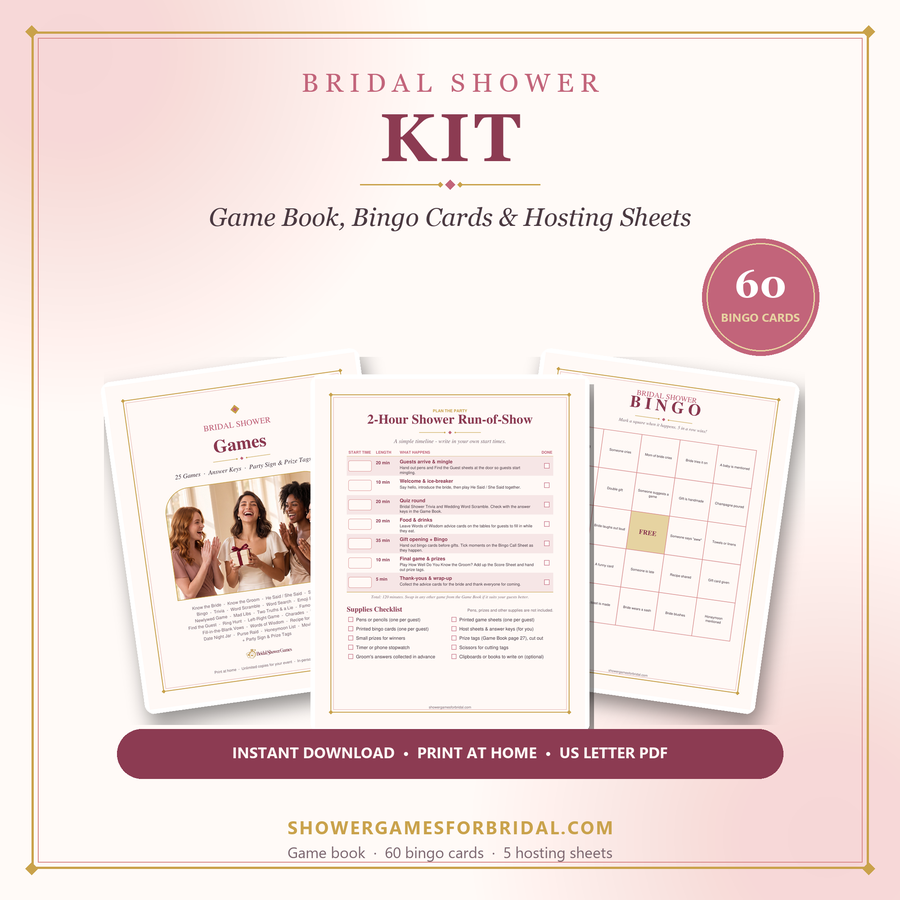
If you prefer designed paper activities, compare the paid packs below. Check each product page for its exact contents; not every browser activity has a matching printable.
For deeper planning help, see the guides on the main site: virtual & Zoom showers, funny games that aren't cheesy, games for large groups and co-ed & couples showers.