

Your ten-minute preparation check
Test the screen and sound if needed, count pens, choose a stopping point and write down the scoring rule. For a bag-and-pocket round, choose ordinary items and let guests report rather than display them. Save personal quizzes for a time when the couple can provide an answer key.
Game options to consider
He Said / She Said
The browser game uses fictional sample answers. For a round about your own couple, collect their answers separately and keep your own score.
▶ Play it free →Two Truths & a Lie
Enter two true statements and one invented statement. Guests vote before the answer is revealed. Only include stories the person wants to discuss.
▶ Play it free →Bridal Charades
Use the prompts for a timed acting round. Guests can volunteer to act, guess or keep score; nobody has to perform.
▶ Play it free →Spicy Truth or Dare
Preview the bride-edition prompts with willing participants. Let guests pass, and choose another activity if the questions do not suit the group.
▶ Play it free →Wedding Emoji Pictionary
Guess the wedding phrase shown by the emoji. Collect answers before revealing so an early guess does not spoil the puzzle.
▶ Play it free →Purse Raid
Read the items while guests check their own bags or pockets. Agree on scoring first and do not ask anyone to display private belongings.
▶ Play it free →Toilet Paper Wedding Dress
Give willing teams paper supplies and a short building period. Agree on judging categories first and ask permission before taking photos.
▶ Play it free →Start with the time and supplies you actually have
When the shower is close, begin by counting the preparation you can realistically finish. Check the device you will use, the number of willing players, the available writing surfaces, and the space in the room. Those details are more useful than choosing a long list of activities and hoping the supplies will appear. A short, tested game is a complete plan.
Low preparation does not mean no explanation. Even a free browser game needs a host to say what guests should do, how answers are collected, and when the round ends. Spend your first few minutes making those decisions. If you cannot explain the activity in a few clear sentences, simplify the format before asking guests to join.
Choose one main activity and one fallback. The fallback should use fewer resources than the first choice, such as a spoken conversation prompt if a display fails. Do not make the backup another screen game that depends on the same unavailable connection. A useful fallback solves the likely problem rather than merely adding another title to your plan.
Separate games you can open from games you must prepare
A ready-made visual or general quiz can be opened and tested without collecting private answers first. A personal quiz about the couple needs their approved key, even if the browser form itself is quick to fill. Do not confuse a short setup screen with complete preparation. The answers are the important material, and the host should not invent them to save time.
Two Truths & a Lie also needs someone to choose true statements and an invented one they are comfortable discussing. That may be easy for a willing person, but it still requires thought and approval. If the party begins in minutes and nobody has prepared statements, choose a different activity rather than putting the guest of honor under pressure to produce a personal story instantly.
The He Said / She Said browser demo uses fictional answers. It can show the format, but it cannot substitute for the real couple's responses. Introduce it honestly if you use it. For a personal round, wait until the couple has supplied answers or run a separate unscored conversation with their agreement.
Make a ten-minute preparation pass
Use the first part of your preparation to open the exact game and play enough to understand the controls. Check whether an answer advances automatically, whether the host must press a reveal button, and whether scoring applies to one device or several players. Do not learn those distinctions while guests are waiting for the next question.
Next, check the room. Can people see the screen? Can they hear you without music competing? Do they need pens, paper, or a clear place to move? Put the necessary items together rather than leaving them in different bags. A helper can distribute supplies while you explain the activity if their role is clear.
Finally, write a short host note with the answer method, scoring rule, and stopping point. You do not need a script for every word, but those three decisions prevent most avoidable confusion. If the setup still feels too complicated at the end of the check, choose the simpler fallback and save the more involved game for another occasion.
Use Wedding Emoji Pictionary for a shared puzzle
Wedding Emoji Pictionary is a useful option when guests can see a screen and want a visual guessing activity. The browser shows a clue and choices, then reveals the result after a selection. For a hosted group, let everyone commit an answer before clicking. An early click can reveal the solution while some tables are still discussing it.
You can run the round cooperatively with the room agreeing on one answer, or keep separate table scores on paper. The browser's score reflects the choices made on the host device. It does not automatically know what each table wrote. Explain that difference once so guests do not mistake the displayed number for the competition's complete result.
Check the emoji from the farthest seat. A clue that looks obvious beside the laptop may be too small across the room. Read the visible objects and answer choices when needed, without adding extra hints. If the screen cannot be made comfortable, use a smaller group around a device or choose an activity that does not depend on tiny visual details.
Use a belongings round without asking for private displays
A bag-and-pocket activity can be quick to explain because guests already have the relevant objects with them. Choose ordinary items and let people report what they have. Avoid asking them to empty bags, reveal personal documents, or show private phone content. The game can be light without turning someone's possessions into a public inspection.
If you use the Purse Raid browser activity, inspect its prompts and host controls before starting. If you prefer a shorter self-reported list, present it as your manual variation and write the points down. Do not imply that a custom list has been uploaded into the game unless the interface actually provides that feature.
Tell guests whether an item scores once regardless of quantity and how they should report it. A simple one-point-per-item version is easy to total manually. Let anyone without a bag observe or team up if that suits the rules. Arriving with fewer belongings should not become a joke about preparedness or personality.
Keep charades voluntary and physically simple
Charades can work with a small amount of preparation if the prompts fit the audience and the space. Read a few before choosing the game. Guests should understand the kind of action they may be asked to perform, and actors should be able to pass or redraw. Someone can enjoy guessing without wanting to stand in front of the room.
Clear a small area and avoid prompts that encourage climbing, lifting, or rushing around furniture. A mime does not need a physical stunt. Explain whether speaking is allowed, how long a turn lasts, and who keeps score. If you are using a separate timer or paper tally, call those host arrangements rather than automatic features of every charades format.
Start with a willing volunteer instead of choosing the quietest guest as a surprise. A comfortable first turn helps others understand the activity. Keep the pace moving, but leave room for a pass without commentary. The goal is shared guessing, not proving that everyone is equally outgoing.

Choose a paper-building activity only when supplies are ready
A toilet-paper dress activity needs actual paper supplies, space, and willing participants. It is not a no-preparation choice simply because the concept is familiar. Check that you have enough materials for the planned teams and that the venue allows the activity. If gathering supplies would delay the shower, select a puzzle or conversation game instead.
Ask who is comfortable modeling and who would rather build or judge. Do not wrap someone without their agreement or restrict movement, breathing, or visibility. Teams can create a small tabletop design instead if wearing a construction is not suitable. Present that as a manual variation and keep the expectations modest.
Agree on judging categories before building begins, such as a clear theme or an inventive detail, rather than announcing that one team is simply the best. Ask permission before taking or sharing photographs. A short making activity can be enjoyable, but the host should not assume everyone wants a costume image kept or posted.
Be selective with truth-or-dare formats
Truth-or-dare activities need a group that wants that kind of interaction. Preview the prompts and explain that passing is allowed. Do not use the format as a shortcut to make a quiet room lively; unexpected personal questions can make guests withdraw rather than participate. A close-friends gathering and a mixed family shower may need very different boundaries.
Keep dares harmless and optional, and do not make alcohol, touching another person, or revealing private information a condition of participation. A guest can choose another prompt or observe. If several people seem uncomfortable, switch activities without asking them to justify it. The host's flexibility is more useful than insisting a particular game should be funny.
When preparation time is very short, a neutral puzzle may be easier to host than a format requiring careful screening. That is a practical choice about the available time, not a judgment about the guests. Save a more personal activity for a setting where you can review it properly with the people involved.
Write a short opening that gives guests a choice
An effective opening names the task and its length: “We are doing a short picture round while everyone finishes their drinks. You can join your table's guesses or just watch. Write one answer before I reveal it, and we will stop after the planned round.” Guests then know what participation looks like and that it has an ending.
Avoid promising that everyone will laugh or that nobody can dislike the activity. Those claims add pressure and are impossible to guarantee. Instead, explain the simple mechanics and begin with a clear example. A host who is calm about participation makes it easier for guests to try something unfamiliar.
If the activity includes personal material, say that the person involved approved it. If it uses a fictional sample key, say that instead. If scores are manual, name the person keeping them. These small truthful details build trust because guests understand what they are seeing and what the game can actually do.
Choose one answer method and keep it
For a screen puzzle, decide whether guests shout, write, raise a hand, or answer as a table. Written or simultaneous answers reduce the chance that one fast voice spoils every clue. A cooperative spoken round can be simpler when scoring is not important. Choose based on the room rather than assuming the loudest format is the most entertaining.
If guests write, provide enough time for a short answer and collect the commitment before revealing. If tables discuss, appoint a writer or spokesperson so several people do not give different final answers. If the room answers together, accept that the displayed score represents a shared choice and does not rank individuals.
Do not change to speed scoring halfway through because one table is ahead. A new rule can make earlier answers and later answers incomparable. If you want to change the format, close the current round and introduce a new unscored variation. Clear boundaries are easier to follow than a game that keeps changing to produce a preferred result.
Keep scoring lighter than the activity
A single point per correct answer is often enough for a manual group quiz. Write table names on a sheet and mark points as you reveal. Avoid bonus systems that require the host to track speed, confidence, and answer quality at once. Extra arithmetic can make a low-preparation game harder to manage than the original activity.
For a fictional four-question round, a table with three matching answers has three points, and a table with two has two. If one question is spoiled by an accidental reveal, remove it for everyone and report the result out of three. That clear correction is better than privately awarding uncertain points based on who says they had already decided.
Let ties remain ties if a small prize is involved. If you want a tiebreaker, prepare it before play. Do not ask an unplanned private question about the couple or invent a challenge requiring supplies you do not have. A shared result can end the activity neatly and return attention to the shower.
Match the activity to the room's energy
Watch what guests are already doing. A room deep in conversation may appreciate an optional wishes card more than an announcement that everyone must stop for a game. A group waiting quietly for food may welcome a short shared puzzle. The same activity can feel different depending on when it is introduced.
Begin with a small commitment. Explain one round rather than announcing an hour of games. If guests are engaged and the schedule allows, offer another. If they seem ready to move on, end clearly and continue the event. You do not need to prove that the original plan was correct by extending an activity people have already finished enjoying.
Avoid interpreting quietness as failure. Guests may be concentrating, listening, or simply comfortable observing. Look for confusion or discomfort rather than demanding constant noise. A calm puzzle with a few thoughtful comments can be a successful part of a shower even if it does not produce a dramatic reaction.
Include people who need a different way to participate
Offer a seated role for physical games and a spoken explanation for visual ones. Let a teammate write for someone who prefers not to. Read small answer text aloud when needed. These adjustments can be made without announcing personal reasons or making a guest explain a limitation in front of the group.
Keep participation options visible in the initial instructions. A guest can act, guess, keep score, or observe in a charades round; a table member can discuss without being the spokesperson. When choices are offered to everyone, nobody has to request a special exception just to take part comfortably.
If the activity remains awkward for several guests, change it. A different game may be easier than layering more rules onto the first one. The host can say, “Let's switch to a seated puzzle,” and move on. A practical adjustment does not need an apology or a discussion of who caused the change.
Prepare for a screen or connection problem
Keep one simple non-screen activity ready in your host note. You could invite guests to suggest a local outing for the couple or write a short wish on plain paper. These are manual alternatives, not hidden offline modes of the browser games. The fallback should use materials you already have and a prompt you can explain without further research.
If the screen fails during a scored round, pause and decide whether you can recover fairly. A question revealed to only part of the room can remain unscored. Do not keep clicking through a broken display while guests guess what they missed. A short reset is less confusing than continuing a competition with unequal information.
If recovery will take more attention than the activity deserves, use the fallback and return to the technical issue later. The party should not become a troubleshooting session around the host's laptop. A clear change of plan keeps guests involved while preserving the relaxed purpose of the gathering.
Use a simple short-event sequence
For an illustrative compact plan, begin with arrivals and conversation, introduce one short puzzle after people settle, then return to food or the planned celebration. Leave an optional written wish available afterward. The exact minutes depend on the event, so treat this as a sequence rather than a universal schedule that every shower must follow.
If you add a second game, choose a different kind of participation. Two consecutive quizzes can feel repetitive even when their topics differ. A quiet written activity after a spoken group round offers a change without requiring more performance. Check that the second activity has a clear reason to be there rather than using it simply because it was already printed.
Tell guests when the last round begins and what follows it. “This is our final clue, then we will bring out lunch” helps everyone understand the pace. A definite ending makes even an improvised plan feel organized. It also keeps enthusiastic players from unintentionally extending the game while other guests are ready to move on.
Choose paid materials only when they solve a real need
The optional packs listed on this page can save preparation when their actual contents fit your event. Review the product previews and included activities before buying. Do not assume that every browser game has a matching printable or that a PDF includes physical supplies. A last-minute purchase is useful only if you can download, print, and use it in the time available.
If your printer is unavailable, a paid paper pack does not solve that immediate constraint. A free browser activity or a plain spoken variation may be more practical. If your main concern is arranging several coordinated sheets, a prepared pack may help. Choose according to the work remaining, not the idea that buying something automatically makes the event more professional.
Whichever materials you use, the final preparation is the same: inspect them, understand the rules, gather the supplies, and choose a stopping point. Guests experience the clarity of the activity, not the route by which you obtained the page. A simple free game can feel considered when the host has tested it and knows how to guide the room.
Finish the preparation with one clear decision
Before guests arrive, write down the name of the activity you will actually run and put the other ideas aside. Keep the fallback nearby, but stop expanding the plan. Last-minute hosts can lose useful preparation time comparing options after they already have a workable choice. Testing the chosen game is more valuable than collecting another ten possibilities.
Brief anyone helping you on one concrete role: distribute pens, keep the manual score, operate the screen, or collect finished sheets. Avoid having several people announce different rules. A short handover lets helpers contribute without turning the activity into a committee meeting in front of guests.
Then focus on welcoming people. The game is one part of the shower, and it should support the reason everyone came together. Clear instructions, accurate expectations, and permission to participate comfortably matter more than a complicated activity list. With those pieces in place, a modest plan can feel organized and personal even when preparation time is short.
Optional paid printable packs
If you prefer designed paper activities, compare the paid packs below. Check each product page for its exact contents; not every browser activity has a matching printable.
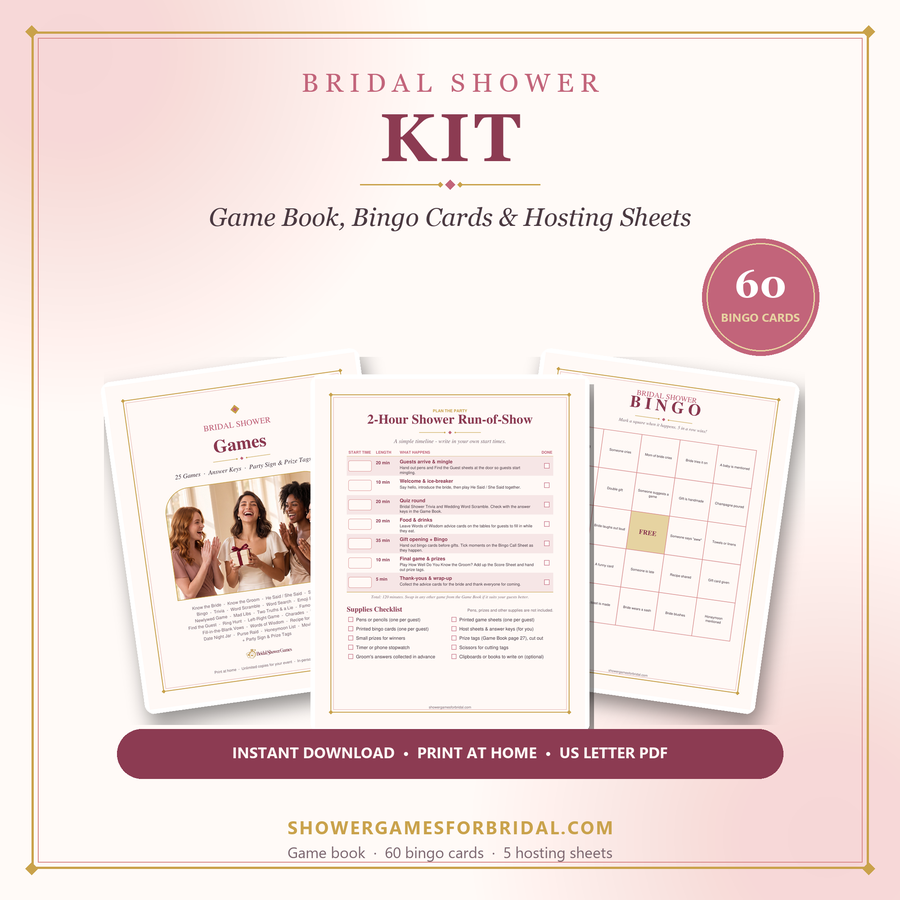
For deeper planning help, see the guides on the main site: virtual & Zoom showers, funny games that aren't cheesy, games for large groups and co-ed & couples showers.
Keep reading
More questions hosts ask
Which last minute games need no preparation at all?
Games that use what guests already carry: What's in Your Purse, What's on Your Phone and a quick scavenger hunt. Two Truths and a Lie and a browser trivia round need only one phone or laptop. Any of these can start within five minutes of deciding to play.