

Try these gentle questions
Who would bring an umbrella on a sunny day? Who would pack extra snacks? Who would choose the longest route for a better view? Who would remember a spare charger? Ask the partners to agree on a key beforehand. If their answers differ, let “no agreed answer” be part of the reveal without penalizing guests.
Game options to consider
Mr. & Mrs. Quiz
Choose questions the couple is comfortable sharing, prepare the answers and compare them during the party. Either partner can skip a question.
▶ Play it free →Spicy Truth or Dare
A bride-edition twist on the classic — optional questions and performance prompts; preview the cards and allow passing.
▶ Play it free →Bridal Charades
Use the prompts for a timed acting round. Guests can volunteer to act, guess or keep score; nobody has to perform.
▶ Play it free →Toilet Paper Wedding Dress
Give willing teams paper supplies and a short building period. Agree on judging categories first and ask permission before taking photos.
▶ Play it free →Purse Raid
Read the items while guests check their own bags or pockets. Agree on scoring first and do not ask anyone to display private belongings.
▶ Play it free →“Drink If…”
Read a prompt and let guests decide whether it applies. A non-alcoholic drink or a show of hands can replace sipping, and any prompt can be skipped.
▶ Play it free →Wedding Emoji Pictionary
Guess the wedding phrase shown by the emoji. Collect answers before revealing so an early guess does not spoil the puzzle.
▶ Play it free →Choose humor the couple wants to share
A funny couples shower game begins with a shared invitation, not with a plan to catch either partner off guard. Ask both people which kinds of questions and activities they enjoy. One may like acting out wedding moments while the other prefers a seated quiz. They may both enjoy harmless preference questions but dislike prompts about arguments, former relationships or money. Those preferences give the host a useful creative brief. Removing an unwanted topic leaves more room for a joke everybody can enjoy.
Think of the funny moment as a reveal of an approved detail or an unexpected creative choice. A partner choosing a surprising snack for a day trip can be lighthearted without exposing a private disagreement. A team making an exaggerated paper train can be amusing without commenting on the model’s body. A story assembled from unrelated words can surprise the whole room without choosing a person as the target. These are different sources of humor, and the group may prefer one over another.
Avoid promising that a game is guaranteed to make everyone laugh. Guests have different tastes, levels of familiarity and energy. A quiet smile, a short conversation or an enjoyable shared puzzle can be a good outcome. The host should not respond to a calm room by making questions more intimate or adding penalties. Choose the format, explain it clearly and let the participants decide how much they want to contribute.
Build an approved couple question round
For a host-prepared question round, send both partners the prompts before the event. Ask them to agree on an answer or identify where their answers differ. You can use Partner A, Partner B, Both or No agreed answer. Those options avoid forcing a binary choice when it does not fit. Keep the key private until guests have guessed. This is a manual party format, not a customization feature of the browser He Said / She Said demo, which uses fictional sample answers.
Choose questions that guests can understand without knowing a long backstory. “Who would pack extra snacks?” is easy to picture. “Who did that thing on the trip?” is not. A question can still be personal when it concerns a familiar habit, but the wording should give newer acquaintances a fair chance to make a guess. Do not make guests prove how long they have known the couple in order to participate.
If the partners disagree, decide whether that is part of the reveal or whether the prompt should be omitted. You can say, “They did not choose the same answer, so this one is for conversation rather than points.” Do not punish guests for failing to match a key that never existed. A disagreement can be a small amusing moment without becoming a public negotiation about which partner is right.
Use these host-prepared prompts thoughtfully
Who would pack extra snacks
Ask the couple for the answer they want to use, then invite guests to write A, B or Both. A short follow-up can be “What snack would they choose?” if the couple is happy to share it. Do not add that as a scored question unless you collected a key. The first prompt is about a harmless preparation habit; the second is an optional conversation. Keeping those roles separate makes the scoring clear while leaving room for a personal detail.
Who would take the scenic route
This can invite a light story about choosing a view over a faster journey. Avoid presenting it as proof that one person is always late or irresponsible. If the couple says they both prefer the scenic route on holidays but not on workdays, include that context in the question. Specific context makes the answer fairer. Guests should not have to guess which situation the host silently had in mind.
Who would remember a spare charger
A charger prompt is easy to understand and does not require anyone to show their phone. Do not turn it into a search of personal devices or a joke about who is addicted to a screen. The answer can be one partner, both or neither. If neither is the agreed answer, let that be part of your host key rather than changing it because the sheet has only two columns. A flexible paper format should reflect the real answer.
Who would choose the music for a road trip
Collect a simple answer about who usually chooses or whether they take turns. If the couple wants, ask for one approved song title as an unscored reveal afterward. The host does not need to play audio for the prompt to work. Avoid making guests sing as a surprise penalty for a wrong guess. A volunteered chorus is different from a performance required by the rules.
Who would bring an umbrella on a sunny day
This prompt uses an exaggerated but recognizable choice. Explain whether you mean being prepared in general or a specific trip if the couple asks. Do not claim that one answer is statistically more likely for a bride or groom. The key comes from these two people, not stereotypes. If the image makes them laugh and they agree to share it, it can be a useful opener before more personal preferences.
Who would stop to photograph a view
Keep the question about an ordinary habit rather than judging whether someone takes too many photographs. The couple can answer together and optionally name a place they enjoyed visiting. Ask before displaying any actual photograph during the shower. The question does not require access to their camera rolls. A spoken, approved memory is enough to give the reveal context.
Who would suggest trying a new recipe
The answer can start a conversation about curiosity rather than cooking ability. Do not turn it into a test of who performs household work or who should cook after marriage. A couple that does not cook much can skip it or interpret it as choosing a new food to try. Use their agreed interpretation in the briefing. The host’s job is to make the prompt fit the people, not to make the people fit a fixed expectation.
Who would plan a surprise day out
Check that both partners are comfortable with the idea of surprises before using this one. Some people prefer advance notice, which is not a flaw to tease. The approved answer may be that one proposes the idea and the other handles the details. “Both” can be a complete key. If the couple describes a real plan that is still private, leave that detail out of the event reveal.

Keep the scoring light and consistent
For a manual A-or-B round, one point per match is enough. Give guests one place to write each response and close guessing before revealing. If Both and No agreed answer are possible, put those options on the instructions. Do not introduce them halfway through because a question becomes awkward to score. The host should know which prompts are competitive and which are only for conversation before the first sheet is distributed.
Suppose six questions have agreed answers and a seventh has no shared answer. If the seventh is unscored, announce the competition as out of six. A guest with five matches has five out of six, regardless of what they wrote for the discussion prompt. This simple example prevents an entertaining reveal from making the arithmetic confusing. The game does not need an elaborate percentage or compatibility category to produce a clear result.
If two guests tie, acknowledge both or use a prepared tie procedure. Do not suddenly ask an intimate question to separate them. A neutral extra prompt with an approved key is an option, but joint recognition may fit the social setting better. Physical prizes are optional, and a winner should not have to perform a dare to receive one. Keep the reward attached to the announced game rather than adding a surprise test after the result.
Choose a browser game that matches the intended role
Mr. & Mrs. Quiz lets the host enter answers to ten fixed prompts and mark matches after the bride guesses. It is useful when the couple wants that particular format and approves the questions. The browser counts the host’s match-button decisions; it does not recognize spoken answers. The Newlywed Game has eight fixed prompts and asks the host to tally matches separately. Neither should be described as a scientific measure of relationship quality.
He Said / She Said uses a fictional sample couple’s answer key. It can be played openly as a demo, but it is not a personalized quiz about the real couple. For your own who-would-do-it questions, use a separate prepared key and manual tally. Do not tell guests the browser has selected the “right” partner based on their personality or on statistics. Its answers are simply predefined fictional choices.
Two Truths & a Lie allows the host to enter a complete trio and an optional second round, with the lie identified in setup. It can provide a personal reveal if the statements are approved. The browser does not collect every guest’s vote or keep a full guest leaderboard. Ask guests to vote before the reveal and record individual points yourself if needed. A truth should not be included merely because the host thinks its owner ought to be willing to discuss it.
Add a creative game when the couple prefers less disclosure
Mad Libs can create a funny result from unrelated words rather than personal facts. The browser asks for ten word types and uses one of three story templates. Guests provide words before seeing the story, then a willing reader shares the result. There is no score or saved-story export in the game. If the group wants to keep a line, copy it manually before starting again. The humor comes from the combination, not from pretending the story describes the real couple.
For a host variation, ask each table to supply one word in turn so no one person fills the entire form. Explain simple examples for adjective, verb and plural noun. If the crowd includes people who are less comfortable with grammar labels, offer a prompt such as “a describing word” instead of making that uncertainty the joke. The host can help with the form without choosing every answer. A shared unexpected story remains possible even when the instructions are gentle.
Wedding Emoji Pictionary is another option when the couple does not want personal questions. It is a multiple-choice puzzle with a fixed key and one device score. Teams need a separate host tally. The clues are shuffled, not arranged to become progressively harder. Wrong interpretations can be amusing when their owner wants to explain them, but the host should not read out an identified guest’s answer just to get a reaction without considering whether they are comfortable.
Use acting and building with volunteer roles
Bridal Charades gives teams sixty-second turns with wedding prompts. The actor should see the prompt privately, and the host or actor records correct guesses. People can choose to guess, operate the screen or watch instead of acting. Decide rules about speech, sounds and props before starting. The browser does not judge those behaviors. A clear rule lets the actor focus on communicating the prompt rather than wondering what the host will allow after the performance.
A paper-dress activity needs more preparation and time. Ask for willing models, provide equal supplies and explain the judging categories. The browser’s default build timer is ten minutes, followed by human-entered creativity, elegance and structure scores. That means the whole activity needs more than ten minutes once briefing, judging and cleanup are included. Do not squeeze it into a short gap and then omit half the teams’ presentations because time has run out.
For both activities, describe the output rather than the person when commenting. “That enormous paper bow made the design clear” is different from judging someone’s body or appearance. “The ring gesture helped the team guess” focuses on the acting choice. Ask before photographs, and allow a participant to stop. A funny craft or gesture can be enjoyed without requiring the person involved to accept public teasing or a posted image afterward.
Keep belongings and personal stories optional
Purse Raid can work as a light item-finding game if guests choose what to show from bags or pockets. The host reads each item and awards its displayed points to qualifying players. It does not require emptying a bag or inspecting private phone content. Every qualifying player can score once per item under the normal browser format. If the host wants a speed variation, that rule needs to be explained separately before the first item.
Drink If can use nonalcoholic drinks, a raised hand or no response. The browser has cards rather than a score, so there is no need to count how many apply to each guest. Do not turn it into a ranking of friendship or experience. A guest can respond without telling a story, and a story can be skipped halfway through if the speaker changes their mind. The host should make those choices real, not merely mention them once and then pressure people for details.
Truth or Dare requires particular care in how it is introduced. The deck includes performance prompts and some actions involving photos or messages. Guests should be able to pass without a penalty, and any other person affected by an action should be considered too. Do not call every dare harmless for every group. Preview the cards, use the next-player flow to pass when needed and choose another game if the tone does not suit the couple’s guests.
Put together a short couples-game sequence
One possible sequence begins with a cooperative emoji puzzle, moves to a few approved couple questions and ends with a voluntary creative activity. The first lets guests join without personal knowledge. The second gives the couple a focused moment. The final activity offers another way to contribute. This is a planning example, not a required order. If the couple wants only the question round, there is no need to add more games to make the shower feel complete.
Allow time for transitions. Distributing answer sheets, reading the scoring rule and checking a tie all take longer than a single browser click. Choose one game to omit if conversation runs long. A host can say, “We are keeping the rest of the time for catching up,” rather than rushing through an extra deck. Fewer clearly run games can leave more space for the couple and guests to enjoy the reactions that arise naturally.
Avoid combining multiple personal quizzes with nearly identical questions. A Know the Bride round followed immediately by a couple quiz about the same preferences may feel repetitive. If you use more than one, identify the different purpose of each and remove overlapping prompts in your manual plan. The fixed browser question sets cannot all be rewritten, so a shorter selection of filled answers or a separate host-created list may be the practical choice.
Use host language that supports the joke
An opening can be: “The couple has approved these questions. Some answers may surprise us, but nobody has to explain more than they want to. Write one guess, then we will reveal their key.” This tells guests where the humor comes from and how to participate. After a mismatch, try “That was a different prediction” rather than a line about the couple not knowing each other. The host’s wording can keep a light moment from becoming a personal judgment.
When a guest offers a funny explanation, let them finish if the people involved are comfortable, then return to the next step. Do not keep repeating the answer to force another laugh. If a joke does not land, move on without declaring the room unresponsive. A simple transition such as “Let us see the next question” protects the pace. The host does not need to outperform the guests or manufacture a reaction after every reveal.
If someone makes an unwelcome comment, redirect clearly: “We are keeping the questions within the couple’s approved topics.” Then continue with a safer prompt or end the round. Avoid asking the couple to publicly judge whether the comment was acceptable. The host can enforce the boundaries already agreed without making them defend those boundaries in front of the room.
Finish with the couple, not just the score
At the end, announce any result in modest terms: the most matches in this round, the completed shared puzzle or the team total. Thank both partners for contributing what they chose to share. Invite a closing thought only if they want one. The point of the shower is celebrating them, and the game should return attention to that purpose rather than leaving the room focused on an argument about one answer.
Keep personal answer keys and photographs according to the couple’s wishes. Do not assume that something shared during a party should be posted publicly. If guests ask for the question list, you can share the neutral prompts without automatically sharing private answers. A small amount of care afterward helps the funny moment remain a positive memory for the people who made it possible.
Optional paid printable packs
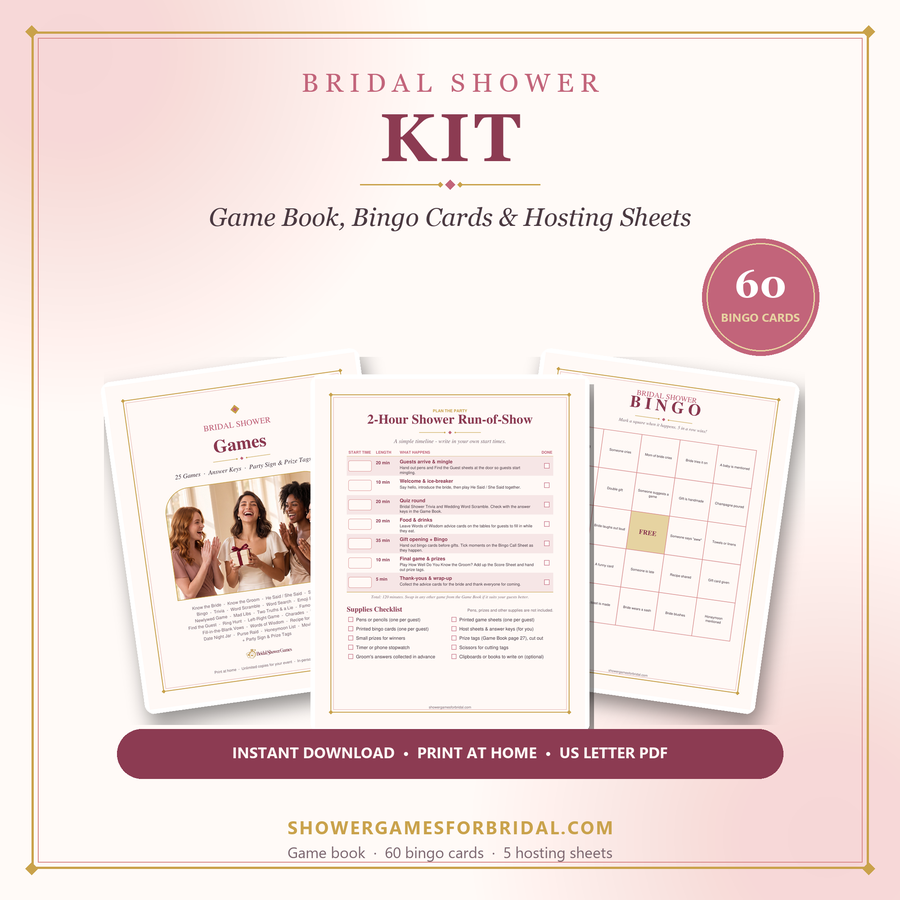
If you prefer designed paper activities, compare the paid packs below. Check each product page for its exact contents; not every browser activity has a matching printable.
For deeper planning help, see the guides on the main site: virtual & Zoom showers, funny games that aren't cheesy, games for large groups and co-ed & couples showers.