

Six questions to copy
Where did you first meet? What meal do you enjoy cooking together? Which film would you both watch again? What is a place you would like to visit? What activity do you enjoy on a free weekend? What song reminds you of a happy memory? Ask permission before using personal details. Award one point per answer that matches the prepared key, allowing agreed equivalent wording.
Game options to consider
He Said / She Said
The browser game uses fictional sample answers. For a round about your own couple, collect their answers separately and keep your own score.
▶ Play it free →Would She Rather
Use paired choices to guess the bride’s preference. Ask her to confirm the answer; a personal preference is not a universal fact.
▶ Play it free →Two Truths & a Lie
Enter two true statements and one invented statement. Guests vote before the answer is revealed. Only include stories the person wants to discuss.
▶ Play it free →How Well Do You Know the Bride?
Enter the bride’s approved answers beforehand. Guests guess before the host reveals each answer. Keep separate totals for multiple guests or teams.
▶ Play it free →The Newlywed Game
Prepare one partner’s answers, then ask the other partner the same questions. Written answers work; a recorded message needs permission and separate playback outside the browser game.
▶ Play it free →Mr. & Mrs. Quiz
Choose questions the couple is comfortable sharing, prepare the answers and compare them during the party. Either partner can skip a question.
▶ Play it free →Decide who is guessing about whom
A couple-knowledge game can ask guests to guess the couple's answers, or it can ask one partner to predict the other's answers. Those formats look similar on a page but create different experiences. In a guest quiz, several people can write simultaneously and compare with a prepared key. In a partner-comparison round, the couple's responses become the focus while guests watch or make their own predictions. Choose one structure before collecting questions so the answer key matches the actual game.
For a mixed shower, a guest quiz about everyday preferences can give everyone a reasonable entry point. A partner-comparison round needs the couple's agreement to be in the spotlight. Do not surprise them with questions they have never approved simply because the title sounds familiar. Ask whether they want a scored competition, a conversation activity, or a short combination of both. Knowing that preference helps you select questions and decide whether a disagreement should earn no point, invite a story, or simply be passed over.
Build the answer key before the party
Send the chosen questions to the relevant partner or both partners in advance. Ask them to answer independently if comparing their responses is part of the game. Keep the request brief and explain which answers guests will see. They should be able to remove a question without providing a reason. A short approved set is more useful than a long list with gaps that the host tries to fill from memory. The couple supplies the facts; the host organizes them.
Record the exact answer and any acceptable equivalent wording. If the answer is a restaurant, note whether the cuisine alone will count. If it is a destination, decide whether a country is sufficient or whether the intended city is required. Ask about ambiguous responses while you still have time to clarify them. Do not make the bride settle every wording dispute during the party. A prepared key with a few equivalence notes keeps scoring consistent and allows the couple to enjoy the game instead of working as its referees.
Choose questions that do not reward only old friends
Guests will have different kinds of knowledge. A sibling may know childhood memories, a coworker may know lunch preferences, and a new friend may know recent hobbies. Mix accessible preference questions with a few approved shared stories rather than building the entire quiz around one period of the couple's life. You can also use multiple-choice options that make an unfamiliar answer approachable without requiring insider knowledge. Those options are part of a host-made quiz unless the browser already supplies them.
Avoid questions whose main purpose is to reveal who knows the couple best in a socially loaded way. A lower score does not mean a guest cares less or belongs less at the celebration. Frame the game as discovering a few things about the pair. If you want to award points, keep them attached to the answers rather than to friendship status. Mixed table teams can help guests share different knowledge naturally, and they reduce the chance that a newcomer spends the whole round watching other people recognize private references.
Everyday preference questions to copy
Try questions such as: “What meal would you choose for an evening at home?” “Which kind of outing would you both enjoy on a free afternoon?” “What snack disappears first on a road trip?” “What film would you happily watch again together?” “Which room do you most enjoy spending time in at home?” Ask the couple to approve and answer whichever questions fit their lives. Do not assume they live together, travel regularly, or share every preference.
You can make these questions easier by offering three plausible choices supplied by the couple. For example, a favorite evening might be cooking, a walk, or a movie. The correct answer is the couple's prepared response, not a universal fact about how couples behave. If they choose different answers, that can be a conversational reveal rather than a problem to conceal. Label the key clearly: one partner's preference, the other partner's prediction, or an agreed shared answer. The label determines what guests are actually trying to match.
Shared-memory questions with clear boundaries
Useful prompts include: “Where did you first meet?” “What was an early activity you enjoyed together?” “Which small moment from a trip still makes you smile?” “What meal did you first try cooking together?” “What song connects to a happy shared memory?” These can lead to warm stories, but only use details the couple has chosen to share. A familiar question can still have a private answer or a complicated history, so approval matters more than how innocent the wording appears.
Keep each scored answer short enough to judge. If the prompt invites a long story, ask for a simple key phrase and allow the fuller story after scoring. For instance, guests might name the location, then the couple can choose to explain what happened there. Do not require dates down to the day unless the couple specifically wants that kind of detail and guests have a fair basis for guessing. The memorable part is often the reveal, not the precision of a fact that only two people could reasonably know.

Future-looking questions that leave room for uncertainty
Ask about hopes without turning them into announcements. “What hobby would you like to try together?” “What kind of weekend would you enjoy planning?” “What skill would you like to learn as a pair?” “Which place would you like to explore if the opportunity arose?” These questions can invite imagination while avoiding the assumption that a plan is booked, affordable, or settled. Tell guests that the answers describe preferences at the time the key was prepared.
Avoid questions about children, housing purchases, salary, or major commitments unless the couple has independently asked to include them. A shower quiz is not the place to extract a timeline for private decisions. If a preference changes between preparation and the event, let the couple say so without treating it as a mistake. You can score against the prepared answer and acknowledge the update, or remove the question from competition for everyone. Choose a response that keeps the couple comfortable rather than making them defend consistency for the sake of one point.
Light comparison prompts need real answers
“Who packs earlier?” “Who suggests the movie?” “Who is more likely to save a restaurant recommendation?” “Who checks the weather before a day out?” These are possible host-written comparison prompts. Ask the couple to approve the wording and decide whether “both” or “neither” should be allowed. Do not force a choice between two people when the truthful answer is shared or depends on the situation. A flexible answer key can be more recognizable and less stereotyped.
The free He Said / She Said browser game uses fictional sample answers. It does not know which partner in your real couple packs first or chooses the film. If you use those personal comparison prompts, create a separate sheet and keep your own scores. Explain the distinction to guests before play. You may demonstrate the fictional browser format as a game in its own right, but do not present its key as evidence about the couple. Personalization requires information the couple actually supplied, not merely a title that sounds personal.
Use the right browser tool for the preparation you have
How Well Do You Know the Bride? and the corresponding groom game use fixed prompts with host-entered answers. The Newlywed Game also uses a prepared-answer structure for comparing a partner's response with the key. Mr. & Mrs. offers its own fixed question set and host-managed matching. These tools can organize a reveal, but they are not unlimited question editors. If your custom list uses different prompts, run it separately on paper or in a document.
Check the setup on the actual host device. Enter only approved answers, leave out questions the couple wants to skip where the tool permits blank answers, and rehearse the reveal privately. Supported setups save locally and can use optional same-account backups to restore a missing local setup. They do not merge competing edits or share answers with another account, so verify the final hosting device. Keep a separate approved key so you can recover from switching laptops or clearing browser data. Also distinguish the screen's score from guest competition: multiple guest or table totals generally need a separate host tally.
Create a guest answer sheet that explains itself
Put the game title, a name or team-name line, and numbered questions on the sheet. Leave enough room for the kind of answer you expect. A one-word preference needs less space than a short shared memory. Keep the numbering identical to your host key and reveal order. If you use multiple choice, label the options consistently so guests can write a letter instead of copying a long phrase. Check the sheet with somebody who has not seen your notes.
Add the simple scoring rule at the top: “One point for each answer matching the prepared key; equivalent wording counts.” Adjust that sentence if some questions are unscored. Do not mix scored questions and open-ended wishes without marking the difference. A guest should not discover during marking that a heartfelt response was being judged against a hidden correct answer. Print a test copy and check readability. If you are making the sheet yourself, describe it as your own preparation rather than implying the browser exports a matching free PDF.
Host a reveal that leaves room for the couple
Ask guests to finish writing before the first answer is shown. Read the question, invite a few guesses if the couple enjoys that interaction, and then reveal the prepared response. Keep the order consistent so people can mark the correct line. The couple may add a brief comment, correct a misunderstanding, or simply smile and move on. Do not demand an anecdote after every item. A reveal can be satisfying without becoming a long interview.
If one partner is absent, a written answer key is enough. A recorded message is optional and requires their agreement about what will be played and to whom. Test the recording privately if you use one, but keep the written key as backup. Do not promise that the game itself hosts or stores personal videos. The browser can reveal prepared text, while any video is a separate part of your presentation. Keep those materials organized so you do not accidentally expose private notes while switching between the two.
Use a sample host script to set expectations
You might say: “The couple approved these questions and gave us the answers in advance. Write your best guesses with your table. You do not need to know every detail; part of the fun is hearing the reveal. We will give one point for a matching answer and accept clear equivalent wording. A question can be skipped, and the couple can decide how much of any story to tell. Tied teams will share the win.” This describes a manual team quiz.
For a partner-comparison version, change the opening: “We have one partner's prepared answers, and the other partner will guess before we reveal them.” Tell guests whether they are also guessing on paper or simply watching. Do not leave the audience uncertain about when to speak; shouted answers can spoil the partner's response. Ask them to hold suggestions until invited. Clear roles make the activity more enjoyable and prevent the host from repeatedly interrupting guests who thought they were supposed to help.
Score equivalent answers without overcomplicating the game
Use the equivalence notes prepared with the key. “At the bookshop” and the exact name of that bookshop may identify the same place if that is the standard you announced. A vague answer such as “somewhere in town” may not. Apply the same interpretation to all sheets. If a question turns out to be ambiguous, remove it from everyone's possible total or accept the reasonable alternatives consistently. Do not award points based on which guest argues most confidently.
For a relaxed gathering, guests can mark their own answers. If teams want a more structured competition, have neighboring tables exchange sheets after writing is complete. Keep totals separate from any browser result that represents only the host's selected answers. A cohost can collect the final table scores while the main host manages the reveal. If you make a marking error, correct it plainly before prizes are announced. The social purpose of the game does not require pretending that a hastily written answer key could never contain a mistake.
Adapt for guests who know only one partner
Give every team a mix of easier preference questions and a few specific memories. A guest who knows the bride through work may contribute to everyday questions even if they have never met the other partner. Provide a short introduction to both people before the game if needed, but do not reveal the scored answers in that introduction. You can also make the round unscored and invite guesses as a way to learn about the couple together.
Avoid team names or comments that divide guests into insiders and outsiders. “The real friends will know this” is an unhelpful introduction even if intended as a joke. Instead say, “This one may be a surprise.” If a question depends on a private family reference, either explain enough context for a fair guess or leave it as a story after the scored round. The event should welcome people from different parts of the couple's life, not arrange them into a hierarchy based on how much history they share.
Plan a remote round with private guesses
Use a separate meeting service and share only the question or reveal window guests need to see. Keep the answer key out of the shared view until the appropriate moment. Ask participants to write guesses on paper or hold their chat responses until a common signal. Otherwise, the first visible answer can influence everyone else. If guests use chat, assign a cohost to collect responses and keep the manual score while the main host speaks with the couple.
Allow spoken answers or an unscored watching role for people who cannot comfortably type during the call. Keep the number of questions modest enough that there is time for actual conversation. If a participant loses connection, let them rejoin without drawing attention to missed points. The browser does not automatically make the personal quiz a synchronized multiplayer competition. You are combining a prepared reveal with your meeting tool and chosen scoring method. Test that combination with one helper before inviting the whole group.
Handle disagreements as information, not entertainment
Two partners may remember the same event differently or choose different answers to a supposedly shared preference. That does not need to become a test of their relationship. Ask in advance how they would like such moments handled. You can reveal both responses, accept either for guests, or remove the question from scoring. A gentle “You have two versions of that story” is enough if the couple seems comfortable; move on if they do not want to discuss it.
Do not encourage the room to vote on which partner is right about a personal memory. Avoid turning a harmless mismatch into a running joke that follows the couple through the rest of the event. The host controls whether the atmosphere stays affectionate or becomes adversarial. Keep your attention on their reaction rather than on generating a dramatic reveal. If a question unexpectedly touches a sensitive subject, skip it immediately and continue with a neutral one. You do not need to explain the private reason to the guests.
Finish with a shared moment rather than more testing
After the final answer, give guests a minute to total scores and announce the result using the rule you explained. Recognize ties simply or use a prepared, approved tiebreaker that gives everyone the same opportunity. Avoid adding an improvised question about the couple's private life because only one prize remains. You can also finish without a winner and invite guests to write one wish for the pair. Mark that as an open contribution rather than another answer to be judged.
Keep the approved key with the host until the event is over, then handle it as the couple requested. Do not automatically publish their personal answers in a blog post, group album, or social update. Permission to use a detail at the shower is not permission to distribute it everywhere. Thank the couple for preparing the responses and let the next part of the celebration begin. A successful knowledge game leaves guests with a few new, willingly shared details and gives the couple control over the stories they chose to tell.
Optional paid printable packs
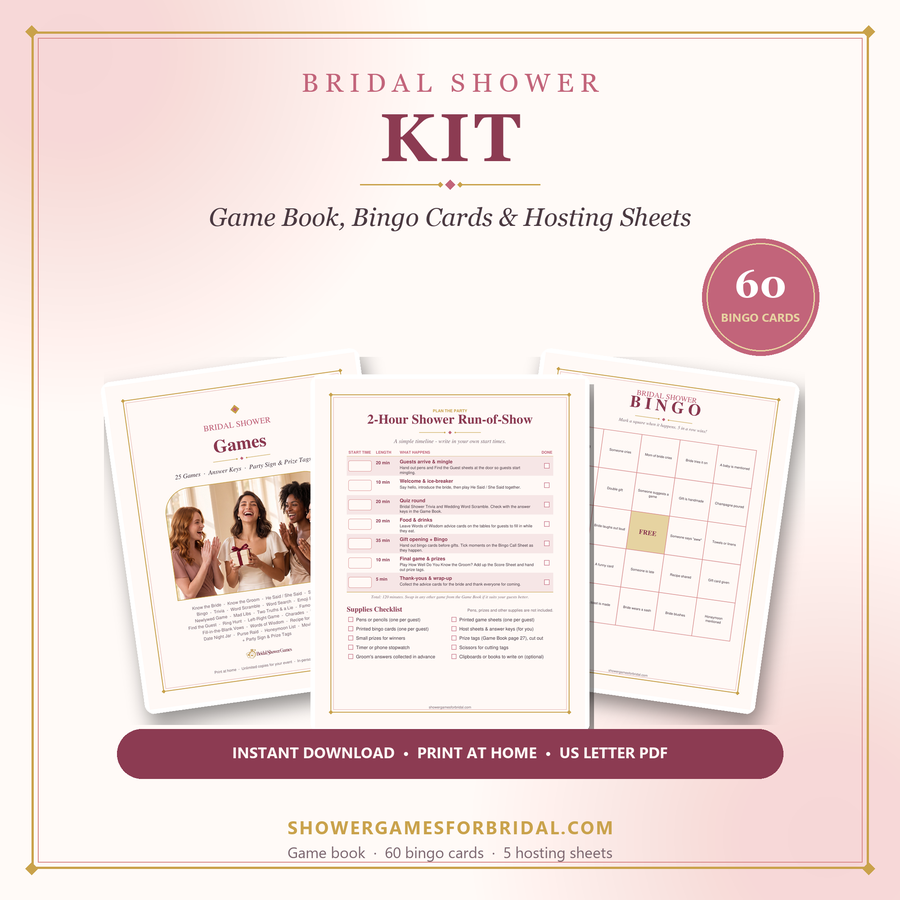
If you prefer designed paper activities, compare the paid packs below. Check each product page for its exact contents; not every browser activity has a matching printable.
For deeper planning help, see the guides on the main site: virtual & Zoom showers, funny games that aren't cheesy, games for large groups and co-ed & couples showers.
Keep reading
More questions hosts ask
Who knows the couple best: how do you run that game?
Collect 10 to 15 answers from both partners ahead of time, read each question aloud and have guests write their guesses. Award a point per correct answer and name the guest with the most points 'who knows the couple best'. Include a few questions newer friends can answer, not only old history.