

A small-group round to try
Ask the couple for two true stories and one invented story. Give everyone a minute to choose, then reveal the answer. Invite questions only if the couple wants to tell more. Follow with a five-minute puzzle so the same people are not speaking throughout.
Game options to consider
Guess the Movie Quote
Read a movie quote and choose a title from the options. Preview the references and keep separate guest or team scores if needed.
▶ Play it free →Honeymoon Price Is Right
Choose an answer in the illustrative price quiz. Its values are game examples, not current travel or retail quotations.
▶ Play it free →Two Truths & a Lie
Enter two true statements and one invented statement. Guests vote before the answer is revealed. Only include stories the person wants to discuss.
▶ Play it free →Mr. & Mrs. Quiz
Choose questions the couple is comfortable sharing, prepare the answers and compare them during the party. Either partner can skip a question.
▶ Play it free →He Said / She Said
The browser game uses fictional sample answers. For a round about your own couple, collect their answers separately and keep your own score.
▶ Play it free →How Well Do You Know the Bride?
Enter the bride’s approved answers beforehand. Guests guess before the host reveals each answer. Keep separate totals for multiple guests or teams.
▶ Play it free →The Newlywed Game
Prepare one partner’s answers, then ask the other partner the same questions. Written answers work; a recorded message needs permission and separate playback outside the browser game.
▶ Play it free →Bridal Charades
Use the prompts for a timed acting round. Guests can volunteer to act, guess or keep score; nobody has to perform.
▶ Play it free →Plan for a small circle of guests
A small couple’s shower has room for conversation that can disappear in a larger event. You can hear the story behind an answer, notice when someone wants to contribute and change the plan without making an announcement across a hall. Use that advantage when choosing games. One personal round and one general puzzle may be enough. The personal round celebrates the couple; the puzzle gives guests who know them less well another way to participate. Leave the rest of the time open for food, introductions and the conversations the answers start.
Decide whether “couple’s game” means a game about the guests of honour or a game played by pairs. Those are different ideas. You can celebrate a couple without requiring every guest to arrive with a partner. If you use teams of two, let people choose a friend or join a small group. Do not make relationship status part of the seating plan. A guest attending alone should have the same access to the activity as someone arriving with a spouse. Explain the team arrangement in ordinary terms so nobody has to ask whether they are allowed to join.
Ask both partners what they want from the games
Speak to both guests of honour before building a programme around personal questions. One may enjoy being quizzed while the other would rather hear guests’ stories. Ask which topics are welcome, whether they want to answer live and whether they are comfortable with recordings or photographs. A brief shared answer can guide the whole plan: “We would like a light quiz about food and travel, with no surprise personal questions.” Keep that note with the host materials. It is more useful than assuming the couple’s friends already know where every boundary lies.
If their preferences differ, use a format that does not require one person to perform for the other’s enjoyment. Guests can guess from an approved written key while both partners listen, or the host can read a short story they prepared together. A general movie puzzle can follow. There is no requirement for the couple to compete against each other. The celebration can include both people equally while giving them different roles. What matters is that each person understands the plan and has agreed to the material that will be shared.
Choose one personal activity as the centre of the plan
For a small gathering, a prepared Two Truths and a Lie set can be a useful starting point. Ask the couple for two true shared experiences and one invented experience, all approved for the guest list. Guests make their guesses, then the couple reveals the answer and adds a story if they want. This creates a natural conversation without needing a long questionnaire. Keep the statements similar in length and plausibility. If the invented one is obviously impossible, the round becomes a quick reveal rather than an interesting choice.
A personal quiz is another option, but choose the exact format before collecting answers. Mr. & Mrs. uses ten fixed prompts with the host marking matches. Newlywed has eight fixed prompts for prepared answers and reveals. If you want a custom selection, use your own paper sheet. Do not collect a long question bank and assume it imports into either browser game. Previewing the chosen format first saves the couple from answering material you cannot use and gives the host a clear sequence to rehearse.
Balance personal knowledge with a general challenge
A quiz about the couple may favour close family or longtime friends. Follow it with an activity where the answer is not based on private history. A movie-quote game, written song clue or wedding puzzle can give other guests a chance to contribute. Preview the references rather than assuming everyone shares the same films or music. You can choose a short selection that suits the group, or leave the result unscored. The change of subject also gives the couple a break from being the focus of every question.
Keep the distinction between games clear. Guess the Movie Quote offers title choices for displayed quotes, with questions shuffled rather than arranged as a steadily harder sequence. Honeymoon Price Is Right uses illustrative game values, not live travel or retail prices. Tell guests what kind of answer they are choosing. A game about example prices should not become advice about what a real holiday will cost. Small accurate explanations prevent a light round from creating confusion, and they help the host respond confidently if someone asks why an answer differs from a price they recently saw.
A worked plan for eight guests and the couple
For an example gathering of ten people including the couple, seat everyone where they can hear one another. Begin with food and introductions, then invite guests into a short prepared story round. Give each person a small answer card or let two neighbours discuss a guess together. Read the three statements, allow a thinking pause and collect votes at the same time. Reveal the invented statement and invite the couple to explain one true story. Do not ask each guest in turn to justify their vote unless the group wants a longer conversation.
After a break, offer a general puzzle on a shared screen. Guests can cooperate on one browser attempt or keep separate answers on paper. If they cooperate, the displayed score reflects the group’s selected answers. If they compete individually, keep their totals separately. End after the agreed number of prompts, even if the browser has more available. This sample plan has only two game blocks. It leaves room for ordinary conversation and can easily become one block if the first activity leads to a lively discussion the group would rather continue.

Write questions that include both people clearly
When preparing a custom paper quiz, use names rather than vague pronouns. “Who is more likely to plan a day trip, Avery or Morgan?” is easier to understand than “Who would do it?” once the host is reading from a separate sheet. Decide whether “both” and “neither” are allowed. Ask the couple to agree on the scoring answer or identify whose submitted response guests should match. A question about a shared habit may not have one objective answer, and a game is not the place to force the couple to settle a disagreement.
Avoid treating gender as an answer key. The person who cooks, remembers appointments or plans travel is whoever the couple says it is, not whoever a stereotype suggests. If a question does not fit their lives, replace it. You can ask about preferences, hobbies and future interests without assuming they live together or divide tasks in a particular way. Read the selection aloud to check that it sounds natural. A clear, specific prompt often produces a better story than a supposedly daring question that requires the host to explain what it means.
Prepare a key with accepted alternatives
Suppose the approved answer to a favourite outing is “a walk by the river.” A guest writes “riverside walk.” Those describe the same idea, so a one-point matching rule can accept both. “Any outdoor activity” is broader and may not count. Decide the level of detail before play and give a neutral example to the guests. If a question asks for two items, say whether both are required. Keep the scoring simple enough that a guest can mark a sheet without needing the host to decide a new rule for every response.
Use one final key and keep it off the guest display. If the couple changes an answer during preparation, update the host and helper copies together. If they change it live, remind the group which reference the game uses, or remove the question from the score for everyone. A friendly round can tolerate a discarded question more easily than a long debate. The story behind the change may still be enjoyable. Let the conversation happen if the couple wants, then move to the next prompt without describing the mismatch as a problem in their relationship.
Make guest pairs a choice, not a relationship test
If guests play in pairs, explain that any two people can team up. Friends, relatives and new acquaintances can all share an answer sheet. A small trio is fine if numbers are uneven. For a mixed guest list, pairing people with different connections to the couple can create useful conversation, but do not separate someone from a companion they need for support. The team arrangement should help people participate comfortably. You can invite guests to stay where they are and work with a neighbour rather than turning seating into a complicated matching exercise.
Let each pair decide who writes, or suggest switching roles between rounds. Encourage a short discussion before the answer is final so one confident person does not automatically make every choice. If the group is very small, cooperative play may be more pleasant than team scoring. Everyone can debate one answer and the host selects it on the shared browser. That gives the game a common result without requiring a separate leaderboard. Choose the arrangement that creates the kind of interaction you want, not the one with the most elaborate competition.
Offer charades only when the group wants to perform
Charades can add energy after a seated round, but wait for willing actors. Tell guests they can guess, keep time or watch. Preview the prompts and give a performer a way to exchange one they do not want to act. Clear enough space for comfortable movement and keep drinks away from the acting area. The browser turn lasts sixty seconds and starts immediately when the host selects “Show my prompt (60s),” so the actor should be ready before the reveal. Reading the prompt happens within that countdown. Use Skip without a penalty if the prompt is unsuitable.
At a small gathering, avoid making one person act repeatedly simply because they volunteered first. Offer turns, but do not keep asking a reluctant guest until they agree. If nobody wants another turn, finish the round. You can return to a puzzle or conversation without treating that as a disappointing outcome. Keep comments about the clues rather than the actor’s body or confidence. A funny interpretation is enough on its own; the host does not need to turn it into a running joke about the person who performed it.
Include a remote guest in the same answer window
If one or more guests join by video, position the call so they can hear the host and see the relevant display. Read the question aloud and collect remote answers before revealing it to the room. A helper can watch the chat or repeat a remote guest’s response. Do not let in-person guests finish and discuss the answer while someone online is still trying to hear the prompt. Use one clear signal for when guesses are final. A short practice question can reveal whether the arrangement actually gives everyone a fair chance.
The games website does not supply the video-call service. Test your chosen meeting setup and keep a plan for a dropped connection. Remote guests can use paper if switching between chat and a shared screen is awkward on a phone. If the format depends on a recording, confirm permission and test playback separately; the Newlywed game does not provide a general video-upload feature. Keep the written answer available so one technical problem does not halt the gathering. A remote guest should be part of the conversation, not only a face on a screen while the room plays separately.
Keep the supply list small and specific
For a shared-screen puzzle and one paper personal round, you may need only the host device, a readable display, approved answers, guest sheets and pens. Write the list for your actual plan. Do not add props from games you are unlikely to use. Keep a few spare sheets and a backup copy of the key. If you choose a designed printable, inspect its contents before buying and print a test page before making the full set. Browser games and PDF packs are separate formats, so a familiar game title does not guarantee an identical printable is included.
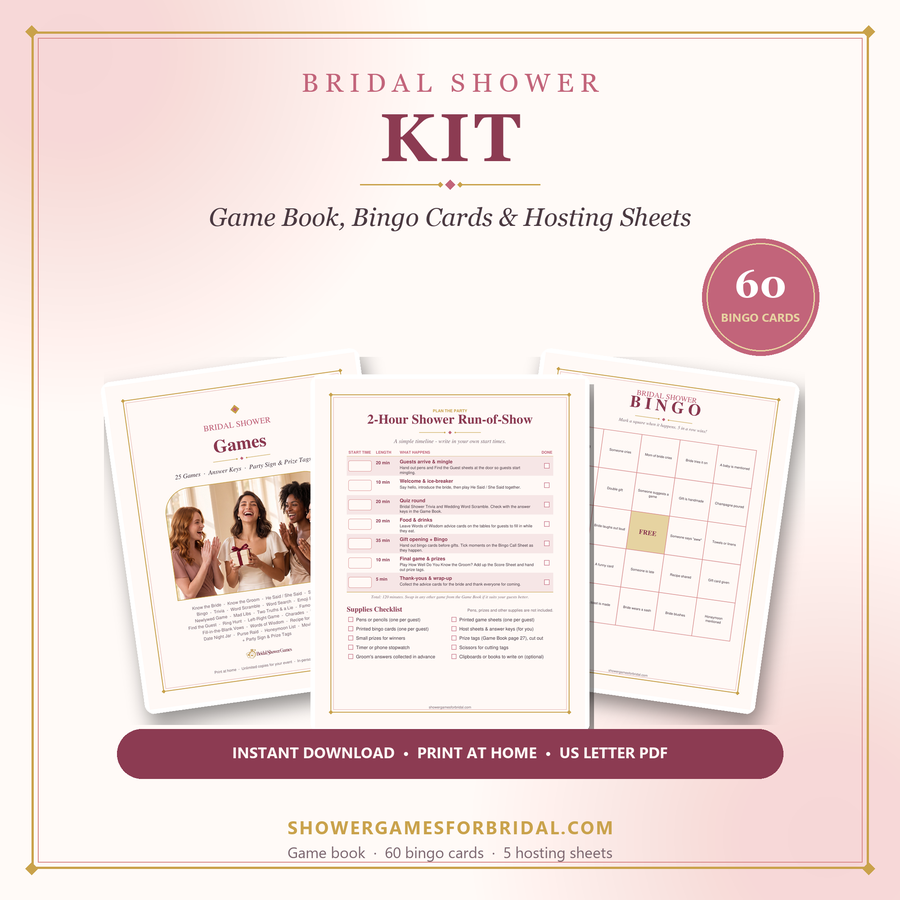
The Bridal Shower Kit is an optional paid product that includes couples games such as the Newlywed Game, the Shoe Game and Famous Couples. Personal questions still depend on the couple’s own responses where applicable. Compare the previews with the activities you want rather than assuming every answer is supplied. For a small gathering, a plain custom sheet may be sufficient. Choose the amount of material that makes hosting easier, not a larger collection simply because you could theoretically play more games.
Leave space for a natural conversation after the reveal
After a personal answer, ask “Would you like to tell us the story?” rather than demanding an explanation. If the couple says no or gives a short response, accept it and continue. If they want to talk, give them a little room and remove an optional prompt later. A small shower does not need the rhythm of a fast television quiz. Guests may enjoy the connection between answers more than the score. The host can support that without allowing every question to expand indefinitely: mark a few prompts that have room for a longer story.
Watch whether one guest is answering for the couple or interrupting their explanation. Redirect with a simple invitation to hear from the person whose answer was revealed. Avoid comparing which guests know them best. A childhood friend may know one topic and a new neighbour another. The game can help those different circles meet. If a story begins to move into a private subject, return to the approved material. A neutral next question is easier to introduce when you have prepared it in advance rather than improvising under pressure.
Choose an ending that fits a small gathering
For a scored round, recognise joint winners or use the tie rule stated at the beginning. For cooperative play, celebrate the shared result and move on. A small prize is optional; the activity can end with the couple choosing a favourite moment or simply thanking everyone for playing. Do not ask them to rank guests by closeness or contribution. If you collected written wishes or approved answers, offer them as a keepsake only if the couple wants them. Keep private preparation notes separate from anything you hand over.
Close the game clearly before returning to food or conversation. Put the answer key away and tell guests whether another activity is planned or optional. This lets people relax without wondering whether they should keep their sheets ready. Later, ask the couple whether the amount and style of play suited them. That feedback is more useful than counting how many games you managed to finish. A successful small couple’s shower gives people a comfortable way to celebrate together, with enough structure to start the conversation and enough freedom to let it continue.
A welcoming opening for a mixed table
Try this introduction for guests who have not all met: “We know the couple through different parts of their lives, so nobody is expected to know every answer. You can guess with the person beside you or write your own choice. We will hear the approved answer, then leave room for a little story if they want to share it.” Add the number of questions and explain the score, if there is one. This gives unfamiliar guests a reason to join in without pretending that everyone has the same background knowledge.
Before the first scored question, use a neutral practice example that is not part of the couple’s key. Show where to write, when to stop and how the reveal works. Ask whether the people at both ends of the table can hear. If two guests are sharing a sheet, let them settle who will write before continuing. These small pauses make the round easier to follow and reduce repeated interruptions later. Once everyone understands, the host can keep the explanation short and let the answers carry the conversation. If a guest joins late, a helper can quietly explain the current question number so the whole table does not have to restart.
Optional paid printable packs
If you prefer designed paper activities, compare the paid packs below. Check each product page for its exact contents; not every browser activity has a matching printable.
For deeper planning help, see the guides on the main site: virtual & Zoom showers, funny games that aren't cheesy, games for large groups and co-ed & couples showers.