

Offer a real alternative
Place a wishes card on the table for people who prefer to stay seated and write. Announce: “You can join this round, watch, or keep chatting.” Stop after one round if the room would rather talk. The more personal options below need the couple’s approval.
Game options to consider
Mr. & Mrs. Quiz
Choose questions the couple is comfortable sharing, prepare the answers and compare them during the party. Either partner can skip a question.
▶ Play it free →He Said / She Said
The browser game uses fictional sample answers. For a round about your own couple, collect their answers separately and keep your own score.
▶ Play it free →Spicy Truth or Dare
Preview the bride-edition prompts with the guest of honour. Use only approved questions and dares, and let anyone pass without explanation.
▶ Play it free →“Drink If…”
Read a prompt and let guests decide whether it applies. A non-alcoholic drink or a show of hands can replace sipping, and any prompt can be skipped.
▶ Play it free →Bridal Shower Mad Libs
Collect the requested words before revealing the story, then invite a volunteer to read the result aloud.
▶ Play it free →Two Truths & a Lie
Enter two true statements and one invented statement. Guests vote before the answer is revealed. Only include stories the person wants to discuss.
▶ Play it free →Toilet Paper Wedding Dress
Give willing teams paper supplies and a short building period. Agree on judging categories first and ask permission before taking photos.
▶ Play it free →Start with the complaint behind the phrase
When someone says bridal shower games are lame, they may mean several different things: the games take too long, the rules are unclear, the jokes feel forced, or guests are pushed into performing. Ask the guest of honor what they want to avoid. That answer is more useful than searching for a game that supposedly pleases everyone. A person who dislikes personal quizzes may still enjoy a word puzzle, while someone who dislikes competition may happily contribute a silly word to a shared story.
You do not need to defend the tradition of playing games. Treat the activity as one option within the celebration. If conversation, food, and time together are enough, the schedule can reflect that. If you do include a game, make its purpose concrete: helping guests learn names, giving the room a shared laugh, or filling a short transition while refreshments are arranged. A purpose makes it easier to choose the right format and to stop when the activity has done what you wanted.
Use three questions to narrow the choice
First ask what guests will actually do: write, talk, guess, search, or act. Then ask what preparation the host must complete: collect approved answers, print a sheet, arrange supplies, or simply test a browser page. Finally ask how the round ends. A game with an unclear ending can feel much longer than its instructions suggest. Choose an activity whose action, preparation, and finish you can explain in a few ordinary sentences.
For example, a short Mad Libs round asks volunteers to provide word types, requires the host to understand the fields, and ends after one story is read. A couple quiz requires approved answers in advance and ends after a chosen set of questions. A dress-building activity needs physical supplies, willing participants, judging rules, and cleanup time. None is inherently more sophisticated than another. The better choice is the one that matches the guests' interests and the host's available preparation, rather than the one with the most enthusiastic description.
Give guests a genuine alternative
An alternative should be something a person can actually do without becoming the center of attention. A wishes card at the table, a quiet conversation corner, or permission to watch the game can be enough. Do not announce that participation is optional and then go around the room asking every nonparticipant why they declined. The host's response determines whether the invitation feels real. A simple nod and a continued welcome are more comfortable than a public attempt to change someone's mind.
Consider how the room is arranged. If everyone must move into a circle and the host leaves one seated guest visibly outside it, opting out may still feel awkward. A table-based activity allows guests to contribute at different levels without a dramatic separation. Someone can suggest one word, listen to the story, and then return to a conversation. You can also set out an unscored activity during arrival instead of stopping the whole event. That gives guests more control over when they engage.
Choose a low-pressure opening activity
An opening game should be easy to enter while guests are still learning names and settling in. A short visual puzzle or a shared fill-in-the-blank story can work because nobody needs extensive knowledge of the couple. Avoid beginning with a personal spotlight question that requires a guest to summarize their relationship with the bride in front of strangers. Introductions can happen naturally at tables before the host asks for any public contribution.
If you use Emoji Pictionary, collect guesses before selecting an answer on the host screen so the first shouted response does not decide the round for everyone. Keep separate table scores if you want competition; the browser only scores the choices made on that device. If you use Mad Libs, collect the requested word types before revealing the story. Neither activity needs a prize to function as an opener. One shared reveal can be enough to give the room a common moment and then return the focus to conversation.
Make a personal quiz affectionate and specific
A couple quiz can feel warm when its questions invite recognizable everyday stories rather than testing who has known the bride longest. Ask the couple to approve the questions and supply answers beforehand. Preferences, routines, and light shared memories are usually easier to manage than questions about money, conflict, or relationship history. “What meal would you choose for a quiet evening together?” gives people something approachable to guess without requiring private details.
Distinguish the browser tools carefully. Mr. & Mrs. uses prepared answers with host-managed matching. He Said / She Said has fictional sample answers in its browser version; it is not automatically personalized to your couple. If you want real-couple statements, collect them separately and run a paper-scored adaptation. Do not let the convenience of a ready-made interface substitute for an actual answer key. Guests should know whether they are guessing a real person's preference or playing with a fictional sample, because those are different kinds of fun.
Use Two Truths and a Lie for stories the person wants to tell
This format works best when the person featured prepares two true statements and one invented statement that they are comfortable discussing. The statements should be believable enough to invite guessing without requiring a dramatic secret. An ordinary travel mishap, an unexpected hobby, or a harmless childhood memory can be plenty. Avoid asking for a confession just to make the lie harder to identify. The host can help shorten wording, but the person should approve the final version.
The browser supports entering the statements and choosing the invented one. Guests vote before the reveal, and the host keeps any group scores separately. After revealing the lie, invite the storyteller to add a comment or move on. Do not demand evidence of the true statements or insist on hearing the full story. A good reveal gives the person control over what they share. One or two short sets can create a memorable conversation without turning the gathering into a prolonged guessing interview.

Let a silly story do the work
Mad Libs can be useful when you want humor without making one guest the subject of every joke. Ask for the word types shown in the browser and enter the suggestions before generating the story. The current tool uses ten fields and selects from a small set of story templates; it is not an unlimited custom-story editor. Let different tables provide a few words each so participation is spread around without requiring every person to speak.
Give practical help when needed: an adjective describes something, a noun names a thing, and an action word should fit the requested form. Do not make somebody feel foolish for asking. Read the resulting story once, with a volunteer if they want the role, and let the odd combinations supply the humor. You do not need to explain why a line is funny or ask the room for a louder response. If it produces a smile and then conversation resumes, the activity has worked without needing another five stories.
Reserve personal dares for willing groups
Truth or Dare may suit close friends who actively want that kind of activity, but it is not a universal solution for guests who dislike games. Preview the prompts and ask the guest of honor whether the tone fits. The browser's truth and dare choices can be skipped, and the activity does not need a points system. Keep passing ordinary and immediate. No one should have to trade a refusal for a penalty, a drink, or a more embarrassing task.
Do not assume that a harmless-sounding dare is comfortable for every person. Sending a message, posing for a photograph, or speaking about a relationship may involve somebody outside the party or create a lasting record. Ask before including those actions and use a simple alternative when needed. If the group includes relatives, coworkers, and people who have just met, a shared story or general puzzle may require less negotiation. Choosing another format is a hosting decision, not evidence that the guests are too serious to enjoy themselves.
Treat drinking prompts as conversation prompts if you use them
A “Drink If” activity can be played with a nonalcoholic drink, a raised hand, or another voluntary signal. The point is recognizing a shared experience, not monitoring how much someone consumes. Tell guests the alternatives at the start and avoid asking why someone chooses one. Do not keep a score of who drinks most or attach extra tasks to passing. The browser displays prompts; it does not make any particular beverage necessary.
Preview the subject matter and skip statements that could expose private information or make a guest uncomfortable. A light opinion or familiar everyday experience is different from asking people to reveal relationship history in a mixed group. If you adapt the activity into a simple show-of-hands conversation, say so clearly and leave scoring out. A few volunteered comments can be enough. There is no reason to continue until every person has signaled or to interpret a quiet response as a challenge to make the prompts more personal.
Make a craft competition optional and manageable
Toilet Paper Wedding Dress is a building activity, so it needs more than a link on the host's phone. Prepare the paper supplies, choose willing teams, and ask who wants to model the result. Modelling is a separate choice from helping build. Guests can contribute design ideas or construction without having anything wrapped around them. Keep materials away from faces and avoid attaching them in a way that restricts movement. Ask before taking or sharing photographs.
The browser provides a timer and host-entered judging for creativity, elegance, and structure. Those scores are decisions made by the judge, not automatic measurements of the finished outfits. Explain the categories before the building period so teams understand what will be considered. Leave time for cleanup and for volunteers to remove the paper comfortably. If the venue is cramped or the group does not want a physical activity, skip this option. A game does not become more professional because it creates a bigger spectacle.
Build a short schedule with room to stop
For a conversation-focused shower, consider one opening activity and one optional later round. A sample sequence might be arrival and refreshments, a short shared story, time to talk, then a couple quiz if the room wants another activity. Treat those as flexible blocks rather than obligations to fill every minute. The actual duration depends on the guests and the format. Rehearse enough to know whether your selected game can fit comfortably without rushing the instructions.
Announce the length in a useful way: “We will do one story” or “We have eight prepared questions.” That is clearer than promising a precise number of minutes you have not tested. If conversation is lively when the next game was planned, the host can postpone or omit it. Keep the supplies ready without making guests feel responsible for using everything you prepared. Good hosting includes noticing when the room already has the kind of connection you hoped the activity would create.
Use language that invites instead of selling the game
You do not need to call a game hilarious, unforgettable, or guaranteed to win over skeptics. Explain what happens and let guests decide how to join. “We will collect ten silly words and read one story” is more informative than “You are going to love this.” A clear description also helps guests know whether they want to write, speak, or watch. Avoid teasing anyone who looks uncertain; they may simply need the instructions repeated or a moment to understand the format.
A useful transition is: “We have a short activity ready. You can join your table, watch, or keep working on a wishes card.” At the finish, say, “That is our last question; thank you for joining in.” These phrases remove uncertainty about the beginning and ending. They also prevent the host from relying on pressure to maintain energy. A room can enjoy a game quietly. The volume of the reaction is not a reliable measure of whether guests felt welcomed or whether the activity suited the celebration.
Handle a flat round without blaming the guests
Sometimes an activity receives little response even when it is well prepared. Guests may be tired, hungry, absorbed in conversation, or simply uninterested in that format. Shorten the round at a sensible boundary and move on. Do not announce that the group is difficult or insist that everyone try harder. A neutral line such as “Let's leave it there and get back to refreshments” preserves the mood without making the change feel like a failure.
Afterward, consider the practical cause. Were the instructions hard to hear? Did the game require private knowledge most people lacked? Was the screen too small? Those observations can improve a later activity if the event still needs one. They do not justify automatically choosing something louder or more personal. Sometimes the appropriate adjustment is to have no second game. The purpose was to support the gathering, and the guests' preference for conversation is useful information about what the gathering needs next.
Keep prizes proportionate to the activity
For a short social game, a modest shared treat or simple recognition is enough. Large prizes can make casual judging feel more consequential than intended, especially for personal quizzes or creative activities where answers are partly subjective. If teams are playing, decide how a prize can be shared before announcing it. If you only have one indivisible item, consider recognizing an individual game instead or choosing a different form of acknowledgment.
Explain ties before the result. Joint winners are often the cleanest option, particularly when the event is meant to feel relaxed. Avoid an unplanned tiebreaker that introduces a different skill or asks for personal information after a neutral puzzle round. You can also leave prizes out entirely and use the final reveal as the ending. A good story, a surprising correct guess, or a clever team answer can be satisfying without becoming a ranked contest. Match the reward structure to the atmosphere you said you wanted.
Choose browser play or paper for a practical reason
Browser games can reduce printing and provide built-in prompts or selected scoring functions. Paper can let tables work at their own pace and avoid gathering around a small screen. Neither format is automatically more polished. Choose based on visibility, device access, preparation time, and how the host will collect answers. Test the actual browser behavior before relying on automatic scoring for a whole room; many games track only the selections made on the host device.
If you want purchased paper materials, read the exact product contents and page previews. Do not assume every free browser activity has a matching PDF, that the files are editable, or that a larger collection contains entirely different activities. Existing packs are optional products, while browser play remains free. You can also make your own simple answer sheet or wishes card. The useful question is whether the material helps guests understand and enjoy the activity, not whether every part of the celebration uses the same format.
Leave guests with connection rather than a completed checklist
Before the shower, choose the smallest set of activities that could meet your aim and prepare those carefully. Check the couple's answers, test the screen, gather supplies, and decide who will host. Then give yourself permission to use less than you prepared. A spare game is a backup, not a commitment the guests must fulfill. The event can feel complete with one well-timed shared moment and plenty of ordinary conversation around it.
After the final activity, let its best moments feed naturally into the gathering. Someone may ask about a volunteered story, compare a puzzle answer, or congratulate a creative team. You do not need to collect formal reactions or ask whether everyone finally agrees that shower games can be fun. The more useful signs are simple: people understood what to do, could decline comfortably, and had time to enjoy the person being celebrated. Those are concrete hosting goals you can plan for without making promises about how every guest will feel.
Give a cohost the same stopping plan so they can help with the transition. If the main host is busy speaking with the bride, the cohost can put out refreshments or gather unused materials without announcing another round. That small agreement keeps the schedule flexible in practice.
Optional paid printable packs
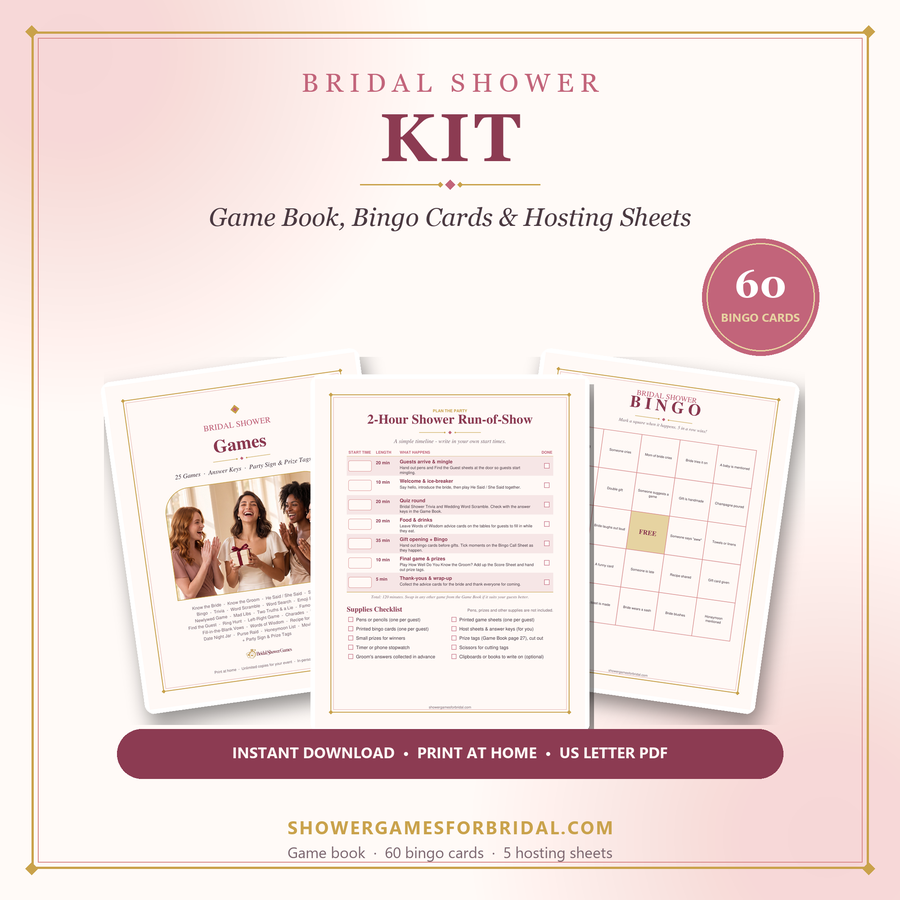
If you prefer designed paper activities, compare the paid packs below. Check each product page for its exact contents; not every browser activity has a matching printable.
For deeper planning help, see the guides on the main site: virtual & Zoom showers, funny games that aren't cheesy, games for large groups and co-ed & couples showers.