

Divide the hosting jobs
Ask one person to explain the rules, one to handle the screen or printed sheets and one to track scores. Put the next activity aside before starting the current one. A simple announcement helps: “We will play for ten minutes, then return to food and conversation.”
Game options to consider
Find the Guest
Match prompts with willing guests and record their names. Explain whether a name may be used more than once, and allow seated guests to take part.
▶ Play it free →Wedding Emoji Pictionary
Guess the wedding phrase shown by the emoji. Collect answers before revealing so an early guess does not spoil the puzzle.
▶ Play it free →Bridal Shower Bingo
Use browser Bingo for a call-out round or gift opening. Test the room and guest cards first, and agree how to handle simultaneous winners.
▶ Play it free →How Well Do You Know the Bride?
Enter the bride’s approved answers beforehand. Guests guess before the host reveals each answer. Keep separate totals for multiple guests or teams.
▶ Play it free →Bridal Shower Mad Libs
Collect the requested words before revealing the story, then invite a volunteer to read the result aloud.
▶ Play it free →He Said / She Said
The browser game uses fictional sample answers. For a round about your own couple, collect their answers separately and keep your own score.
▶ Play it free →Bridal Trivia
Play multiple-choice wedding questions on a shared screen. The browser scores the selected answers; keep separate totals for guests or teams.
▶ Play it free →The Newlywed Game
Prepare one partner’s answers, then ask the other partner the same questions. Written answers work; a recorded message needs permission and separate playback outside the browser game.
▶ Play it free →First, decide which gathering you are planning
“Bridal party games” can mean activities for a bridal shower, a small gathering of attendants or a relaxed evening with the couple’s friends. Start by naming the occasion and who will attend. A mixed-age afternoon shower may suit a seated quiz and a keepsake activity. A small group that already knows each other may prefer stories and a few optional performance games. Neither plan needs every activity on this page. The choice becomes easier when you know whether the main purpose is to introduce guests, celebrate the couple, fill a short pause or spend an entire evening together.
Ask the guest of honour what they would enjoy watching as well as playing. Someone may like guessing games but dislike being the subject of personal questions. Someone else may want friends to share memories while they listen. Write that preference at the top of the plan. It should guide the tone, the amount of preparation and the number of rounds. Do not assume a bridal-party gathering needs embarrassing stories or a competitive score. There is room for puzzles, conversation, creative activities and quiet participation, depending on the people you are bringing together.
Write a small event brief before choosing a pack
A useful brief fits on one sheet: the date, venue, expected guest count, available seating, display equipment and the amount of time reserved for games. Add who is hosting, who can help and whether any guests will join remotely. Then list the materials already available, such as pens, a screen or a printer. This keeps you from choosing an activity that depends on supplies nobody has arranged. It also helps a co-host understand why a simple paper quiz may suit the event better than a game with props or individual device setup.
Separate requirements from preferences. “Guests need to remain seated during food service” is a practical requirement. “We would like one funny round” is a preference that several games could satisfy. “We have no time to collect personal answers” rules out some couple quizzes unless the preparation is completed first. A paid pack may save design work, but it does not decide the event format for you. Read its contents only after you know what you need. That way you can judge whether its activities fit the brief instead of reorganising the party around an attractive cover.
Use the first activity to help guests settle in
Arrivals rarely happen all at once. Choose an opening activity that tolerates people joining at different times, or wait until the group is assembled before beginning a shared round. Find the Guest can provide a reason to introduce yourself, provided guests are willing and the prompts fit the room. Explain whether a name may be used more than once and whether people can answer at their table. Avoid a rule that requires everyone to move continuously through a crowded space. A seated introduction can serve the same purpose when movement is awkward.
The host’s welcome can be simple: “There is an optional conversation sheet on the table. Ask anyone who would like to join in, and we will begin the shared game after food.” That tells late arrivals what is happening without making them feel behind. Keep the opening activity separate from any later score unless you have a clear reason to combine them. Guests who arrive at the stated time should not find they have already lost a competition because others started early. A welcome activity should make entry into the gathering easier, not create a hurdle at the door.
Choose one main activity around the couple’s preferences
The main game deserves the most preparation because it will have the group’s shared attention. If the couple likes personal stories, prepare Know the Bride or a Newlywed round with approved answers. If they prefer a general challenge, choose wedding trivia or an emoji puzzle. If they would rather listen than be quizzed, Mad Libs can invite guests to contribute words before a volunteer reads the story. Match the activity to the couple’s comfort level instead of treating a personal quiz as compulsory simply because the event is about them.
Preview the actual browser game before committing. Know the Bride uses fixed prompts with prepared answers, and Newlywed has its own eight-prompt format. A custom question list from a blog is a separate paper-hosting choice. He Said / She Said uses fictional sample answers in the browser; a real-couple version needs a separately approved key. These details affect what you must collect in advance. A title can suggest a broad idea, but the controls and prompts determine how you can run that particular activity at the party.
Collect personal material with a clear sharing agreement
When you ask the couple for answers or stories, explain who will hear them and what the host plans to do with them. Request a short scoring answer separately from any optional explanation. That lets the host reveal a preference without accidentally reading a private note aloud. Give the couple a chance to remove questions, change wording or choose a different format. Do not treat preparation as a test they must complete. If they have little time, select a smaller set or use a general game that does not depend on personal information.
Keep the final approved version together. Label it clearly so a helper does not mistake an early draft for the answer key. For photos, recordings or written messages, confirm permission to show them at the event and ask separately before sharing them afterwards. A person may agree to a small gathering without wanting the same material posted online. If a browser setup saves answers, check the final content on the hosting device before guests arrive. Keep a simple backup copy of the approved key so the activity is not dependent on remembering which device holds the latest version.

Assign three practical hosting jobs
The speaking host explains the activity and keeps the group together. The materials helper handles sheets, pens, props or the display. The scorekeeper records results when the format needs them. At a small party, one person can do more than one job, but write down who is responsible. Otherwise several co-hosts may assume someone else has printed the sheets or collected the answers. Give each person the same short running order and make clear which activities are optional. That prevents a helper from setting up a round the main host has already decided to skip.
Agree on transitions as well as tasks. Who lowers the background music before instructions? Who brings the next supplies to the table? Who tells the host that food is ready? These details are often what make an event feel organised. A helper should be able to prepare the next activity without interrupting the current reveal. Keep materials in separate labelled groups and put private answer keys away from guest sheets. If the host needs to step out briefly, the helper should know whether to pause, continue reading or move everyone into a conversation break.
Build a running order with room to breathe
Here is one possible sequence for an afternoon gathering: a welcome and optional conversation activity, food, one shared game, open conversation, an optional second activity, gifts or messages, and thanks. The times depend on your event. Rather than filling every minute, decide which parts must happen at a particular moment and which can move. Food service and a guest’s travel time may be fixed; a second quiz usually is not. Mark an optional round clearly so removing it feels like a planned choice rather than a problem.
Include setup and results inside the game block. A sixty-second browser countdown does not include explaining the rules, helping guests find the page or celebrating the result. A personal reveal may need more time because the couple wants to tell a story. If you want a short programme, choose fewer prompts and tell guests where it ends. Do not rush every answer to fit an overfilled schedule. A host can preserve a relaxed atmosphere by dropping one activity while giving the chosen game enough time to be understood and enjoyed.
Prepare guest materials for the chosen answer method
For individual written answers, each guest needs a readable sheet and somewhere to write. For table teams, one sheet per team may be enough, with a few spares. Label the format on your supply list. A stack of sheets does not help if they are host keys, too small to read or numbered differently from the questions on screen. Print one test copy and complete it yourself with sample answers. Check whether a place name or a short phrase fits comfortably in the available space. Plain, usable paper is better than a decorative layout that makes answering difficult.
For browser play, test the actual device and display. A shared screen needs guest scores kept separately if people are giving different answers. Individual devices need a clear start instruction and an explanation of what to do when finished. A supported room needs its own join test. Do not assume that opening the same game link automatically connects everyone. Write the answer method on the host sheet in one sentence, such as “Each table writes one answer before the host reveals.” That sentence should match what the website actually does and what the guests have in front of them.
Explain a round in the order guests need
Begin with what guests will do, then explain when answers are final, how the result is decided and when the game ends. A simple quiz introduction might be: “We will read eight questions. Write one answer beside each number and keep it hidden until the reveal. One point for a match, with equivalent wording accepted. We will announce joint winners if there is a tie.” Change the number and rule to fit your plan. Guests do not need the entire history of the game before they can play it.
Demonstrate one unscored prompt if the format is unfamiliar. Read, pause, collect, reveal and mark a pretend point. Ask whether everyone can hear and see before beginning the scored round. This is especially useful when guests are at several tables or joining by video. Once the pattern is clear, keep later instructions short. If the rules change for a second activity, announce the change rather than assuming guests will infer it. A creative story round, for example, may have no right answers and no score even though the previous quiz did.
Choose between free browser play and designed printables
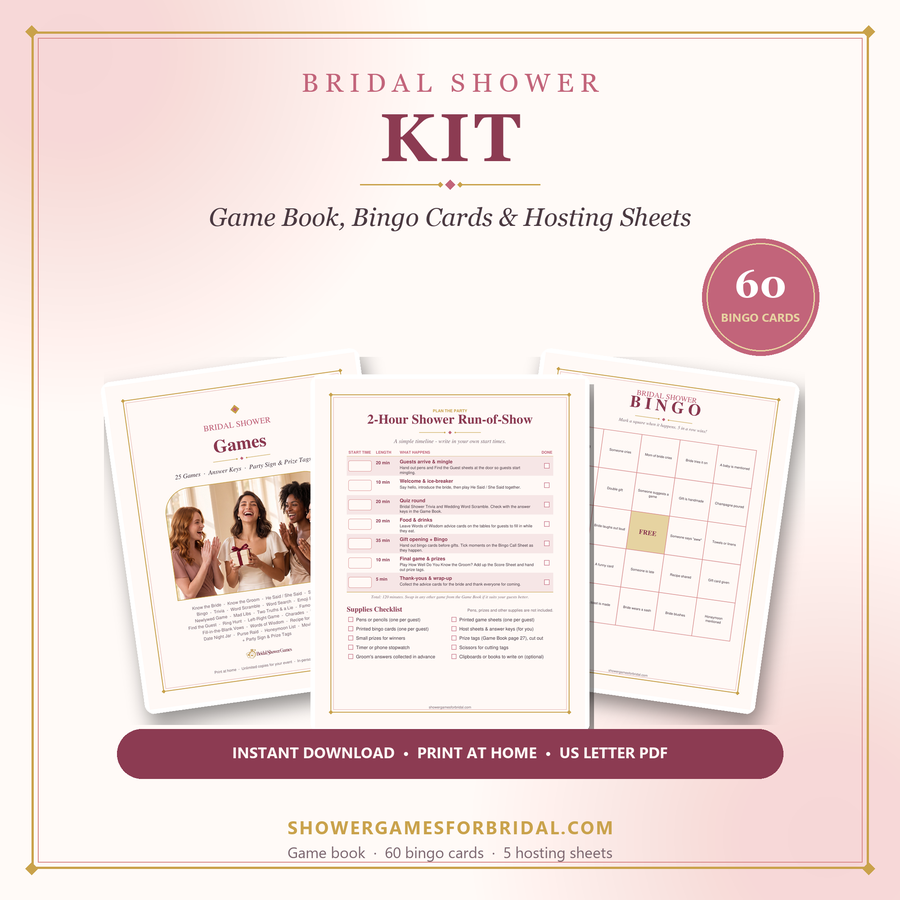
The free browser activities and optional printable packs solve different preparation needs. Browser play can provide a ready display and game controls. Designed PDFs can provide paper layouts that you print beforehand. A pack is not automatically a paper version of every browser game listed in this article. Check the exact product contents and page previews. The Bridal Shower Kit is a one-time $24 purchase: a 32-page game book, 60 Bingo cards and five hosting sheets as fixed US Letter PDFs. Its quick-print files repeat book pages for convenience; they are not extra games.
Think about how you will use the material before buying. If you only need a small personal quiz, a free browser format or your own plain sheet may be sufficient. If you want coordinated paper activities and the listed contents fit your plan, a designed pack may be useful. Download and inspect purchased files ahead of the event, then print a test page. Leave time to solve any printing issue before producing the full quantity. The purchase does not remove the need to choose rules, prepare personal answers or arrange pens and a host.
Keep the whole group involved without requiring performance
Offer more than one way to participate. A guest can guess, write for a team, keep score, read a story voluntarily or watch. Say that passing is fine before anyone needs to ask. For charades, invite willing actors rather than selecting someone publicly and waiting for them to refuse. For games about belongings, let guests check their own items and decide what to reveal. A party can feel lively without treating every guest as a performer. The host should make room for different levels of familiarity, confidence and interest.
Choose seating and movement rules with the actual room in mind. Keep routes clear and offer seated participation in conversation or object games. Read visible prompts aloud for guests who cannot see the display comfortably. In a mixed guest list, balance personal questions with general puzzles so people who know the couple in different ways can contribute. Avoid describing a low score as evidence that someone is a poor friend. The game is a small activity built around selected questions, not a measure of the relationships in the room.
Keep scoring proportionate to the celebration
Use the simplest scoring system that suits the game. A matching quiz can award one point per answer. A story or creative activity can be unscored, or use agreed categories that do not require pretending there is one objectively correct result. Tell guests about ties before play. If prizes are involved, make sure the announced rule fits the number of prizes available. Do not add a surprise speed contest at the end of a thoughtful written round. A result feels fair when the same rules apply to everyone from the beginning.
If a question turns out to be ambiguous, remove it from everyone’s total and continue. If the couple changes an answer, explain whether the game is matching the prepared key or using the live response. Do not spend the party arguing over a single point. A helper can check totals while the host moves into the next transition. Keep individual browser scores separate from manually recorded guest or team scores. The display can reveal the answer without knowing every response in the room, so the host must not present its total as an automatic leaderboard.
Handle a change of plan with one clear announcement
Guests may arrive late, food may take longer than expected or the couple may want more time for conversation. Decide beforehand which activity you can remove. If you skip it, tell the helper and move naturally to the next part of the event. There is no need to apologise for not completing every prepared game. If a display fails, pause the current round and explain what happens to answers already given. Switch to a separate prepared activity or take a break rather than letting part of the room continue while others cannot see the prompt.
Keep a backup that does not depend on the same equipment. A paper key or an approved conversation prompt can work when a browser connection does not. Do not assume offline play or an identical printable exists for every game. The backup should be ready to use, with its materials together. If the remaining time is short, it may be better to thank everyone and continue with food or messages. A flexible host protects the experience of the people at the party instead of treating the written schedule as something that must be completed at any cost.
Close the games and hand over keepsakes thoughtfully
Give the final round a clear ending. Announce the result if there is one, thank the couple for sharing answers and acknowledge the helpers. Tell guests what happens next so they are not left waiting for another prompt. If you collected advice or written wishes, ask the couple how they would like to receive them. Check that private preparation notes are not mixed into the keepsake pile. A copy of approved answers can be a pleasant reminder, but the couple may prefer to keep only the messages rather than every score sheet.
Before sharing photographs or recordings from the games, check permission and what appears in the background. Answer keys, personal notes and guests who preferred not to be photographed may be visible. Save only the material you have agreed to keep. Then make a short note for yourself about what worked: whether guests could hear, whether the setup was easy and whether the chosen number of games suited the gathering. Those practical observations are useful for a future event. The best plan is the one that lets this particular group celebrate comfortably, with activities that support the occasion.
Optional paid printable packs
If you prefer designed paper activities, compare the paid packs below. Check each product page for its exact contents; not every browser activity has a matching printable.
For deeper planning help, see the guides on the main site: virtual & Zoom showers, funny games that aren't cheesy, games for large groups and co-ed & couples showers.
Keep reading
More questions hosts ask
What are good bridesmaid party games?
For the bridesmaids alone, pick games that build on shared history: a quiz about the bride, Two Truths and a Lie, Would She Rather and a toast-writing round. Keep them short because bridesmaids usually have jobs to do on the day.
What games are best for the bride to be?
Games that celebrate her without putting her on the spot: a quiz where guests guess her answers, advice cards, a love-story timeline and Would She Rather. Ask her beforehand which of these she would enjoy; that one question avoids most awkward moments.