

Build three simple activity stations
Set out a wishes card, an optional photo-memory prompt and a shared puzzle. For the memory prompt, ask “What would you like the couple to remember about today?” rather than asking everyone to supply a childhood story. Keep one basket for finished cards and get permission before reading messages aloud.
Game options to consider
Bridal Trivia
Play multiple-choice wedding questions on a shared screen. The browser scores the selected answers; keep separate totals for guests or teams.
▶ Play it free →He Said / She Said
The browser game uses fictional sample answers. For a round about your own couple, collect their answers separately and keep your own score.
▶ Play it free →The Newlywed Game
Prepare one partner’s answers, then ask the other partner the same questions. The browser uses text answers and manual match scoring. Any recorded message must be prepared and played separately with permission.
▶ Play it free →Two Truths & a Lie
Enter two true statements and one invented statement. Guests vote before the answer is revealed. Only include stories the person wants to discuss.
▶ Play it free →Bridal Charades
Use the prompts for a timed acting round. Guests can volunteer to act, guess or keep score; nobody has to perform.
▶ Play it free →How Well Do You Know the Bride?
Enter the bride’s approved answers beforehand. Guests guess before the host reveals each answer. Keep separate totals for multiple guests or teams.
▶ Play it free →Guess the Movie Quote
Read a movie quote and choose a title from the options. Preview the references and keep separate guest or team scores if needed.
▶ Play it free →Design a mix of activities rather than continuous competition
A couples shower brings together people who may know one partner well and the other only slightly. A useful activity plan gives them more than one way to join: a neutral shared game, something about the couple that they have approved, and an optional activity people can approach at their own pace. Not every station needs points, a winner or a host with a microphone. A varied plan can support conversation without turning the gathering into an uninterrupted sequence of instructions.
Begin with the couple’s preferences. Ask whether they want personal questions, public messages, photographs or active games. Decide which parts are central and which are optional. One partner may enjoy a quiz while the other prefers a quiet wishes table. Both preferences can appear in the plan without assigning one person the role of entertainer and the other the role of observer. Give the couple a say in how they participate, not just which questions other people answer about them.
Avoid dividing guests automatically into the bride’s side and the groom’s side. Those groups may be uneven, overlapping or not meaningful to the people attending. Mixed tables can help guests meet, while familiar pairs can make a shy participant more comfortable. Choose according to the actual group. A couples shower does not require guests to arrive as couples, and activities should not make unpartnered guests explain or compensate for their status.
Give every activity a clear purpose
An opener can help guests learn names. A central game can bring the room’s attention together. A wishes station can collect something for the couple. A quiet puzzle can offer a seated option while others chat. Write the purpose beside each planned activity. If two choices do the same job in nearly the same way, keep the one the couple prefers and remove the other. Variety comes from different kinds of participation, not simply a larger number of game titles.
Consider the resources each activity uses. A shared-screen quiz needs visibility and a person operating the device. A photo-memory station needs approved images and a clear way to label them. A craft activity needs working space and cleanup. A personal quiz needs an answer key prepared beforehand. Comparing these requirements helps avoid putting every demanding task on the same host or expecting the same small table to hold food, gifts, crafts and score sheets at once.
Decide whether guests move between stations freely or follow a scheduled rotation. Free movement works when there is no need for every person to complete every activity. A rotation can work for structured groups but needs clear timing and enough space. Do not call a station optional and then require a completed card from every guest at the end. The participation rule should match how the event is actually run.
Set up a wishes station
A wishes station can offer a short prompt such as “What would you like the couple to remember about today?” This lets newer acquaintances contribute without inventing a childhood memory or pretending a long friendship. Other options include a hope for their ordinary days or a small thing worth celebrating together. Choose one or two prompts rather than filling the table with a dozen questions. Guests need a starting point, not another assignment to complete.
For paper, provide blank cards, pens and a clearly labeled collection place. State whether names are optional and whether messages will be read aloud. Keep private notes separate if the couple wants that option. A basket visible to everybody is not a confidential mailbox. If the host plans a read-aloud, ask authors to mark or identify messages they are comfortable sharing rather than assuming every contribution is intended for the whole room.
For digital collection, the Marriage Advice activity works most simply on one shared device. It accepts text and provides Copy all, but the host must paste the collection into a document or message afterward. Separate guest devices do not automatically merge into a communal guestbook. Optional account saving can support backups, but a deliberate checked copy remains the handover plan. Assign a person to do that task so the keepsake does not remain only on a helper’s phone.
Create a photo-memory prompt without requiring old stories
A photo-memory activity can invite guests to describe what they want to remember about the gathering rather than identify people in old photographs. This works when many guests have only recently met. A card might ask for a favorite detail from the day, a message to both partners or a caption for an approved event photograph. Make the photograph optional. Someone should be able to contribute words without being photographed or sharing an image from their own device.
If you display photographs supplied by the couple, ask which ones may be shown and whether they may also be shared outside the event. Label them clearly enough that guests understand the context without guessing private information. Do not turn an image into a quiz about who used to date whom or a prompt for embarrassing stories. The station can celebrate the couple’s chosen memories without opening their entire history for public discussion.
Keep the physical arrangement simple. A small display with numbered images and matching note cards is easier to manage than a pile of unlabelled prints. If you want to attach comments to particular images, provide the number on the writing sheet. Assign someone to collect the cards with the correct photographs afterward. These are host-managed materials; the browser games do not automatically upload, organize or print a shared photo album for this station.

Add a quiet shared puzzle
An untimed puzzle can give guests a way to sit together without performing. Famous Couples Match uses two columns and eight pairs per round, with retries allowed and no built-in timer. Wedding Word Search asks players to select the first and last letters of ten words in a grid and does not record completion time. Either can be used cooperatively on a visible device. The host should explain that guests are finishing together rather than competing against a hidden room leaderboard.
For a station, put a short instruction beside the device and make clear who can touch it. If two people try to tap at once, the puzzle becomes confusing for reasons unrelated to solving. Invite players to alternate finds or agree on a selection before one person enters it. Keep the station away from a crowded entrance or food counter. It should be a comfortable option, not an obstacle everybody must pass around.
If you want a timed contest, prepare a separate stopwatch and tally or use identical paper puzzles for direct comparison. Random browser layouts or selections can differ between attempts. Do not claim that each guest receives exactly the same challenge simply because the game title is the same. A quiet station does not need a prize, and removing timing can make it easier for guests with different reading or input preferences to join.
Choose one central game about the couple
A personal reveal game can provide a shared focus after guests have settled. Collect answers from the relevant partner beforehand and use only approved prompts. How Well Do You Know the Bride and Know the Groom each have eight fixed questions with blank answers omitted. The host reveals entered responses and keeps guest points separately. A shorter set of filled answers can fit a modest time block without rushing through topics the couple would rather skip.
The Newlywed Game uses eight fixed prompts and a text answer key, with manual match tallying. Mr. & Mrs. Quiz uses ten fixed prompts and host-operated match buttons. These are different tools, so pick the one that matches the role you want the couple to have. Neither listens to spoken answers or measures compatibility. If you want both partners answering symmetrically, a separate host-prepared sheet may be clearer than trying to describe fixed bride-and-groom labels as fully customizable.
He Said / She Said is a fictional sample-key game. For a real-couple version, ask the partners to agree on answers to your own prompts and keep a manual score. Tell guests which format they are seeing. A prerecorded video message can be played separately if the couple wants one, but the reveal games themselves accept text and do not provide video recording or playback as an answer feature. Keep that extra media preparation outside the browser instructions.
Use a neutral group quiz when personal questions are unwanted
Bridal Trivia can be hosted as a shared multiple-choice round, while Wedding Emoji Pictionary offers wedding-phrase clues. The browser records the answers selected on one screen. For table teams, have each table write a choice before the host submits one and keep the team totals separately. For cooperative play, discuss and select one group answer so the screen score genuinely represents the shared choices. Both are valid formats when explained clearly.
A quote or song quiz can suit a group that wants popular-culture references, but preview the content rather than assuming everybody has the same interests. Guess the Movie Quote includes film and television references. Name That Love Song uses written clues rather than audio clips. If guests expect to hear music, clarify the text format before starting. Do not build a speakers-and-microphones setup around an audio feature the game does not provide.
Keep the first neutral game short enough to leave time for conversation. If you stop a longer browser deck early for a manual host round, state that the separate tally is the result you are using. There may not be a built-in setting for your preferred question count. The host can select a social format, but should not imply the software has automatically adapted its completion screen to that format.
Offer a creative option with several roles
Bridal Charades can involve actors, guessers and a screen operator. Ask for willing actors, give teams equal turns and explain the rule about speech or sounds. The timer lasts sixty seconds per turn once started, and a person records correct guesses. The browser does not judge gestures. A guest can choose a guessing role without having to perform later as a condition of joining the team. That choice should remain available throughout the activity.
A paper-dress build needs willing models and enough space, supplies and cleanup time. The browser provides a build timer and a judging screen with creativity, elegance and structure scores entered by a person. If the host instead wants to recognize teamwork, that is a separate manual house category rather than the app’s automatic judging. Explain the distinction before teams begin. Avoid making the model’s appearance part of the score; judge what the team constructed.
Mad Libs offers a less physical creative activity. The browser collects ten word fields and reveals one of three story templates. Let different guests supply words and invite a volunteer to read the result. It has no score, and a new story clears the form. Copy anything the group wants to keep before restarting. The activity can involve people without personal knowledge of the couple because the story comes from the supplied words, not a private answer key.
Design the movement between stations
If guests move freely, explain that there is no completion requirement. A small sign can say what the station is, what to do and where finished materials go. Keep the instructions short enough to read while standing. The central host can give one overview, then allow people to choose. Avoid repeatedly interrupting conversations to announce that a station has fewer visitors; the point of optional activities is that participation can vary.
For a rotation, decide the group size and give each station a similar practical time allowance. A ten-minute paper-dress build cannot share a ten-minute rotation with a one-minute puzzle if judging and clearing have not been included. Choose simpler station activities or run the physical build separately. Leave movement time between stations rather than expecting guests to stand, gather belongings and understand the next task instantly.
Place food and drinks away from writing devices and fragile materials. Keep paths wide enough for people to move comfortably, and avoid a station that requires guests to stand in a narrow doorway. A seated option should be genuinely usable from a seat, not described as seated while the supplies are across the room. Ask what arrangements guests need privately and make the station plan fit those arrangements where possible.
Work through three sample activity mixes
A small conversation-focused shower
For a small gathering, set out wishes cards and one cooperative matching puzzle during arrivals. After food, run a few approved couple questions with spoken guesses and no prize. Finish with the couple’s chosen messages or a shared thank-you. This mix gives guests something to do without requiring constant movement or multiple devices. The host’s main work is introducing the personal round and keeping the answer key private until the reveal.
The optional stations can remain available, but they do not need to be completed before the event ends. Assign someone to collect the cards and check that the couple receives them. If the matching puzzle is still unfinished, guests can leave it without a formal loss. The schedule works because the activities support the conversation rather than compete with it for every minute.
A larger shower with several tables
Use one neutral table quiz with one recorder per table, followed later by a voluntary creative activity. Keep wishes cards available at the tables so guests do not queue for a single device. The host needs a clear display, a separate team tally and a helper to collect results. Explain that the screen’s score is not every table’s score. Give the room one submission cue so answers are locked before the correct option appears.
If you include charades, limit the number of turns and provide equal opportunities rather than asking every guest to perform. If the schedule is short, make the creative activity optional to drop. A larger guest count increases transitions and result-checking time. The plan should account for that instead of adding more games simply because there are more people to entertain.
A mixed remote and in-person gathering
Choose activities remote guests can follow through the call. A host-read personal quiz can work if the screen and sound are clear and remote answers have a deliberate collection method. A paper craft happening in the room may be harder for remote guests to join unless they have chosen to prepare supplies. Do not make them watch an extended physical segment without explaining their role or offering an alternative.
Appoint someone to bring remote comments into the room and check that those guests can hear. The browser does not provide the video call or merge every interaction automatically. A separate message collection can include remote wishes with permission. Keep the plan modest enough that one host is not trying to operate a game, serve food, monitor chat and take photographs simultaneously.
Make scorekeeping optional and understandable
Only score activities where a result adds something the group wants. Wishes cards, a cooperative puzzle and a memory station do not need winners. A personal quiz can use one point per accepted match, while a team multiple-choice game needs a separate tally for each team. Write the rule beside the activity so helpers do not invent different systems. If an answer has no agreed key, use it for discussion rather than pretending there is a correct result.
For example, two tables may each have six accepted answers in an eight-question host round. If the plan recognizes ties, both are winners. There is no need to make them perform an unplanned extra challenge. If a tiebreaker is wanted, prepare one with the same conditions for both tables. Prizes can be shared, individual or omitted, but the arrangement should be known before the result.
Avoid awarding points for how personal a story is or how much somebody discloses. That creates pressure in activities intended to be optional. A guest can contribute a short warm wish without being compared with a more emotional message. Recognition can name the participation itself: thanks for writing, guessing, helping or sharing what they chose to share. The event should not rank the guests’ closeness to the couple.
End with a practical handover
Collect physical cards, score sheets that matter, approved photographs and any digital messages. Give each item a named owner for the handover. Copy browser advice into the intended document and verify it before clearing the collection. Keep personal quiz keys private unless the couple wants them shared. Ask before publishing identifiable images or messages; a station activity does not automatically create permission for a public album.
Thank helpers for the specific roles they handled, then return borrowed equipment and restore the space. Make a note of any practical change that would help another event, such as needing a larger display or fewer simultaneous stations. Do not treat the number of completed games as the measure of the shower. A balanced activity plan succeeds when guests could choose a comfortable way to join and the couple’s preferences remained at the center.
Optional paid printable packs
If you prefer designed paper activities, compare the paid packs below. Check each product page for its exact contents; not every browser activity has a matching printable.
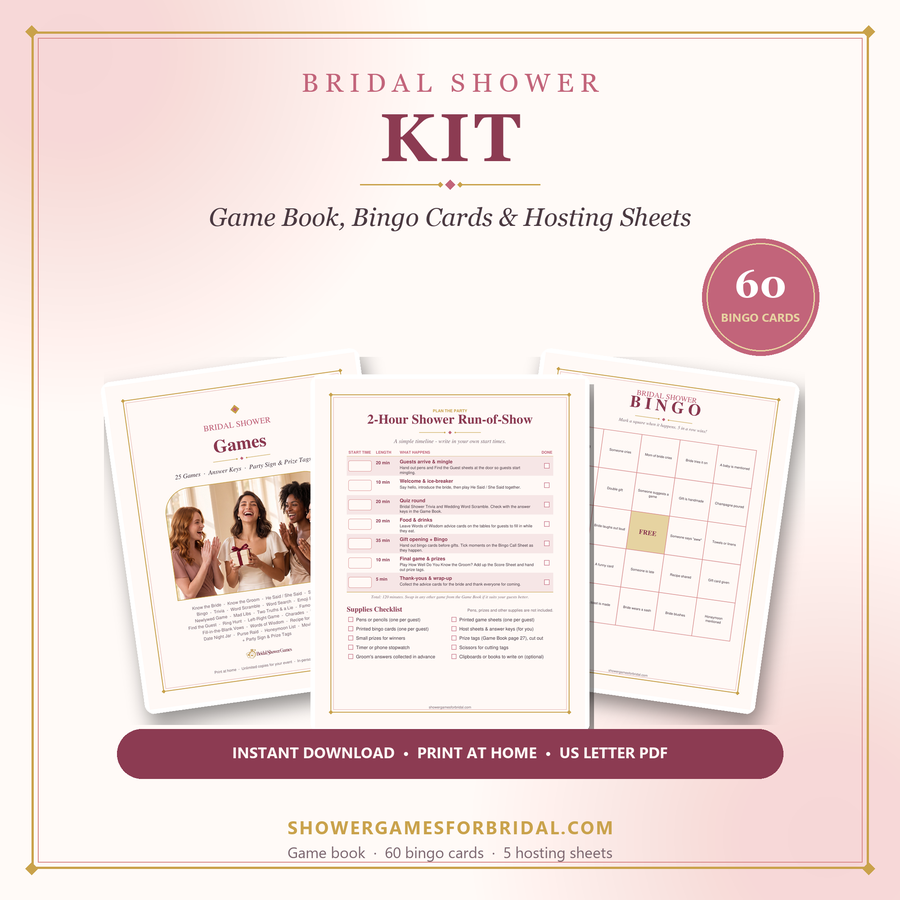
For deeper planning help, see the guides on the main site: virtual & Zoom showers, funny games that aren't cheesy, games for large groups and co-ed & couples showers.