

A five-question shared spotlight
Use names or Partner A and Partner B. Ask who plans journeys, who chooses the film, who packs snacks, who takes photographs and who is more likely to try a new recipe. Tell the audience the partners may pass. End with a congratulatory toast rather than asking for embarrassing explanations.
Game options to consider
The Newlywed Game
Prepare approved answers to eight fixed prompts and reveal them as the host. Keep audience scores separately; recordings require a separate playback setup.
▶ Play it free →Bridal Trivia
Use a short shared-screen quiz when the couple prefers general questions. Keep separate table totals if guests compete.
▶ Play it free →Mr. & Mrs. Quiz
Choose questions the couple is comfortable sharing, prepare the answers and compare them during the party. Either partner can skip a question.
▶ Play it free →He Said / She Said
The browser game uses fictional sample answers. For a round about your own couple, collect their answers separately and keep your own score.
▶ Play it free →Bridal Shower Mad Libs
Collect words before revealing the story. The host or a volunteer can read the result; scoring is optional.
▶ Play it free →Name That Love Song
Use written song clues for a brief audience puzzle. The browser does not play music clips.
▶ Play it free →Two Truths & a Lie
Enter two true statements and one invented statement. Guests vote before the answer is revealed. Only include stories the person wants to discuss.
▶ Play it free →Wedding Emoji Pictionary
Guess the wedding phrase shown by the emoji. Collect answers before revealing so an early guess does not spoil the puzzle.
▶ Play it free →Choose a format for the actual occasion
A wedding reception and a couple’s shower have different demands. At a shower, guests may be gathered specifically for conversation and activities. At a reception, the couple, venue team and other hosts may already have a sequence of food, speeches, photographs and music to manage. Before adding a game, ask the couple whether they want one and agree on where it fits with the person coordinating the schedule. A brief, approved spotlight can work well. A surprise activity that takes over a planned moment can create stress even when the questions themselves are harmless.
For a reception, start with the simplest possible arrangement: a host, the couple and a small set of questions everyone can understand. Guests can watch or make optional guesses at their tables. Save activities with construction materials, bag searches or many individual turns for a shower or a separate gathering where the space and timing suit them. The game cards above offer possible formats, but you should still preview the exact activity. Choose according to the occasion rather than assuming a game that works around a small table will transfer unchanged to a large room.
Agree the spotlight with both partners
Ask both partners what they are comfortable sharing and how long they want to be the centre of attention. Show them the proposed questions rather than describing the tone vaguely as “just a bit of fun.” A preference about snacks or films may be welcome, while a question about disagreements or former relationships may not be. Let them remove any prompt without having to replace it. The host can prepare a few approved alternatives, but there is no need to conceal the list in order to produce genuine reactions.
Decide whether they will answer live, compare prepared responses or listen while guests guess from a key. Each format asks something different of them. A live response can change with the moment; a prepared key gives the host a stable reference. If one partner dislikes performing, a guest-guessing version lets both enjoy the reveal without needing to produce a quick answer in front of the room. Make it clear that either person can pass during the game as well as during preparation. Approval in advance should not remove that choice on the day.
Turn the five-question idea into a complete small round
The five everyday prompts near the top of this page can form a short custom paper or spoken round. Replace the partner labels with names and agree whether the answer options are either name, both or neither. Ask the couple to approve a reference answer for each question if guests will keep score. Put those answers on a host sheet in the same order. Read the wording aloud to make sure it is clear from the audience’s point of view. “Who plans journeys?” may need a more specific phrase if the couple interprets it differently.
Introduce the scope before starting: “We have five questions the couple has approved. You can guess at your table, and either partner can pass. We will finish with the last reveal and a toast.” Add a scoring rule only if you intend to use one. This is a suggested custom hosting format, not a claim that five arbitrary questions can be entered into every browser game. If you use a fixed-prompt tool instead, choose its actual prompts and explain that version. Keep the host’s written plan and the display aligned so the room does not see one question while hearing another.
Choose how the couple will reveal their answers
For a live comparison, each partner can write an answer on a separate card and show it at the host’s signal. Keep the writing large enough to read from the intended distance, then read both answers aloud for guests who cannot see. If the question asks about one named person, make clear that one partner is stating their own preference while the other predicts it. For a prepared-key version, the host reads the approved response after guests have guessed. That can be simpler when the room is large or the couple would rather avoid holding up cards.
A recording is another optional arrangement, but it requires separate playback preparation and permission. It is not a general upload feature inside the Newlywed browser game. Test sound and keep the written answer as a backup. You can use one short recorded message after the round instead of a clip for every question. Avoid making the audience wait through repeated attempts to find the correct file. The reveal should remain easy to follow, with one clear question, one answer window and one result before the host moves on.
Let ordinary prompts create the funny contrast
Questions about snacks, films, travel habits or trying a recipe can produce different answers without needing an embarrassing topic. The host does not have to write a joke into every prompt. The contrast may be that one person imagines a carefully planned trip while the other expects a spontaneous afternoon. Let them explain if they want. Avoid turning a difference into a judgement about which person is organised, difficult or responsible for the relationship. The game is a small glimpse of preferences, not a public assessment of household roles.
Use names and the couple’s own descriptions. Do not assume who cooks, earns more, makes decisions or remembers dates. If a question does not fit their lives, remove it. A prompt can be playful while still being precise: specify whether guests are predicting an approved answer or what the couple will say live. If both responses are reasonable, enjoy the contrast and continue. The host’s reaction matters as much as the wording. A warm observation can keep the moment light; an unapproved follow-up can quickly move it into a subject the couple never agreed to discuss.

Give the audience an easy optional role
Guests can guess quietly at their tables, write answers on a small sheet or simply watch. For a reception, avoid requiring every table to send a representative to the front after each question. That introduces movement and waiting into a short spotlight. If you want table scores, use one writer per table and a helper to collect a complete round at the end. Explain whether the answers will be checked or self-marked. The audience should understand the task without needing to know private details of the couple’s history.
Do not turn guest participation into a test of who knows the couple best. Some guests are relatives, some are colleagues and some are attending with someone else. An everyday preference lets everyone make a plausible guess, and the reveal gives them something new to learn. Keep applause voluntary and avoid demanding a louder response from particular tables. If the audience is listening quietly, that can still be a comfortable reception moment. The host should focus on clear delivery and the couple’s enjoyment rather than trying to manufacture a specific level of noise.
Coordinate sound and the screen before guests are watching
Ask whoever manages the room’s sound how the host should use the microphone and where to stand. Test audibility from the back before the event if possible. Keep the microphone available for the couple’s answers without making them reach awkwardly across props. Lower background music while questions are being read. If a screen is used, check that the text and answer choices are readable from the guest seating. A display that looks clear on the host’s laptop may be too small once it is projected or viewed from a distant table.
Keep the answer key and unrelated notifications off the public display. If a helper operates the browser, agree on a signal to reveal and another to advance. The helper should not click while the host is still collecting guesses. Rehearse one question from introduction through answer so you know where each person looks and what they do. This short run-through catches practical problems such as a hidden button, a cable in a walkway or a microphone that is not ready when the couple begins speaking.
Know the differences between the browser quiz formats
The Newlywed browser game has eight fixed prompts for prepared answers and host-led reveals. Mr. & Mrs. has ten fixed prompts with the host marking matches. Neither is a universal editor for every custom question idea. Preview the exact prompts and choose the format that suits the couple. Keep guest or table scores separately when multiple people are guessing from one screen. A browser result can reflect the host’s selections or marked matches without recording every response in the audience. Explain that distinction if guests ask where their own score appears.
He Said / She Said uses fictional sample answers in the browser. If you want a game about the real couple, collect a separately approved key and run that manual format. Do not introduce sample answers as though they came from the bride and groom. General trivia or emoji puzzles can be alternatives when the couple does not want personal questions. Name That Love Song uses written clues rather than playing audio, which may simplify equipment but changes what the audience should expect. Accurate descriptions make the chosen game easier to prepare and avoid surprises at the microphone.
Time the transitions as well as the questions
A five-question round can still run long if every prompt includes an introduction, a repeated explanation, individual audience guesses and a lengthy story. Decide which parts matter most. If the couple wants to tell stories, use fewer prompts. If the event needs a very brief spotlight, collect guesses together and invite only a short optional comment after each reveal. The timing is a host planning choice, not a promise that a certain number of questions always takes the same number of minutes. Rehearse aloud to get a realistic sense of your own delivery.
Agree on a stopping signal with the coordinator or co-host. If food is ready or another scheduled moment needs to begin, end after the next approved reveal. Mark a warm final question that can be used whenever the round needs to close. Do not repeatedly announce “one more” and continue. The audience should be able to trust the stated ending. A game that stops comfortably after four questions can feel complete, while one that pushes through all ten despite the room’s needs can feel much longer than its actual duration.
Use host language that protects the tone
An opening might be: “The couple has chosen a few everyday questions for us. Make a guess if you would like, then we will see their answers. Either person can pass, and we are here to enjoy the differences.” After a mismatch, try a neutral response such as, “Two different plans for that afternoon.” Then ask whether they want to add anything. Avoid “You should know this” or comments suggesting a wrong answer reveals something worrying about the relationship. The host can acknowledge an amusing contrast without making either person defend it.
For a pass, say, “We will leave that one and move to the next.” Do not invite the audience to speculate. For an ambiguous answer, say, “We will keep that one out of the score.” For a technical failure, say, “I have the approved answer here, so we can carry on.” These small prepared transitions help the host stay calm without overexplaining. They also keep attention on the celebration rather than on the mechanics of the game. Adapt the wording to sound natural in your own voice, while preserving the couple’s choices and the announced rules.
Use a story round when a quiz feels too formal
Two Truths and a Lie can replace a scored couple quiz if the guests of honour prefer sharing a few approved experiences. Prepare two true statements and one invented statement with them. Keep all three plausible and similar in detail. Let guests vote, reveal the invented one and invite a brief story about a true response. This format can be especially suitable at a shower, where there may be more time for conversation. At a reception, use a small set and agree how much explanation fits before the next scheduled event moment.
Do not ask the couple to invent statements on the spot if that was not the plan. Preparation allows them to choose stories they are comfortable telling to this audience. A harmless travel experience or hobby can be enough. Avoid material involving private disputes or other people who have not agreed to be discussed. If the story leads naturally into conversation, let that be the end of the activity rather than forcing a second set. The game has done its job when it creates a pleasant shared moment, even if nobody keeps a score.
Save more involved games for a suitable setting
Some activities need more space, materials or personal participation than a brief wedding spotlight allows. A paper-dress challenge needs willing builders, supplies, a reveal and cleanup. Purse Raid asks guests to check their own belongings and should allow private passes. A drinking-style prompt game needs a clearly optional non-drinking way to participate and an audience that wants that format. These may suit a separate shower or close-friends gathering, but they should not be introduced as an unannounced reception obligation just because they appear on a wedding-game list.
When considering a more involved activity, ask what everyone else will do while one person takes a turn. Long waits can make the audience disengage even if the participant is enjoying it. Use simultaneous written guesses or table discussion where possible. Keep paths clear and avoid interrupting food service with movement. If the venue cannot support the setup comfortably, choose a simpler round. The couple’s celebration does not need every kind of game, and leaving an unsuitable option out is part of a thoughtful plan rather than a missed opportunity.
Keep the result simple and fair
If guests are scoring, announce one point per matching answer and define equivalent wording where relevant. Decide how ties are handled before the round. Joint winners or a small approved extra question can work, depending on the event. Do not add a surprise performance or speed challenge after a written quiz. For a live couple comparison, you may choose not to award points at all. The audience can enjoy the answers without turning the partners’ agreement into a total that invites judgement. Use the scoring method that supports the tone the couple requested.
Keep prizes proportionate and practical for the number of winners. A table team may have several contributors, so decide whether recognition is shared rather than presenting one item without a plan. If checking scores would delay a reception transition, a helper can handle it later while the host closes the spotlight. Avoid making the couple wait in front of the room while papers are counted. The game should have a clear ending even if a small administrative step happens afterwards. A brief thank-you can be enough when the round is unscored.
Close with congratulations and an agreed handover
End on a warm approved question, thank the couple and move into the planned toast or next event segment. Tell the coordinator or co-host that the game is finished so they can continue the schedule. Do not use the ending to introduce an extra surprise question. The couple should feel that the agreed spotlight has been respected. If guests are holding answer sheets, tell them whether to keep them, hand them to a helper or set them aside. A clear closing instruction prevents the room from waiting for another reveal.
Ask before sharing photographs, clips or written answers beyond the event. A funny response in a room of invited guests is not automatically material for a public post. Keep private preparation notes out of any keepsake you give the couple. Afterwards, review whether the chosen format, sound and timing suited the occasion. The most useful success measure is whether the couple enjoyed the moment and the event continued comfortably. A few clear questions, a considerate host and a reliable ending can create that experience without needing an elaborate production.
Optional paid printable packs
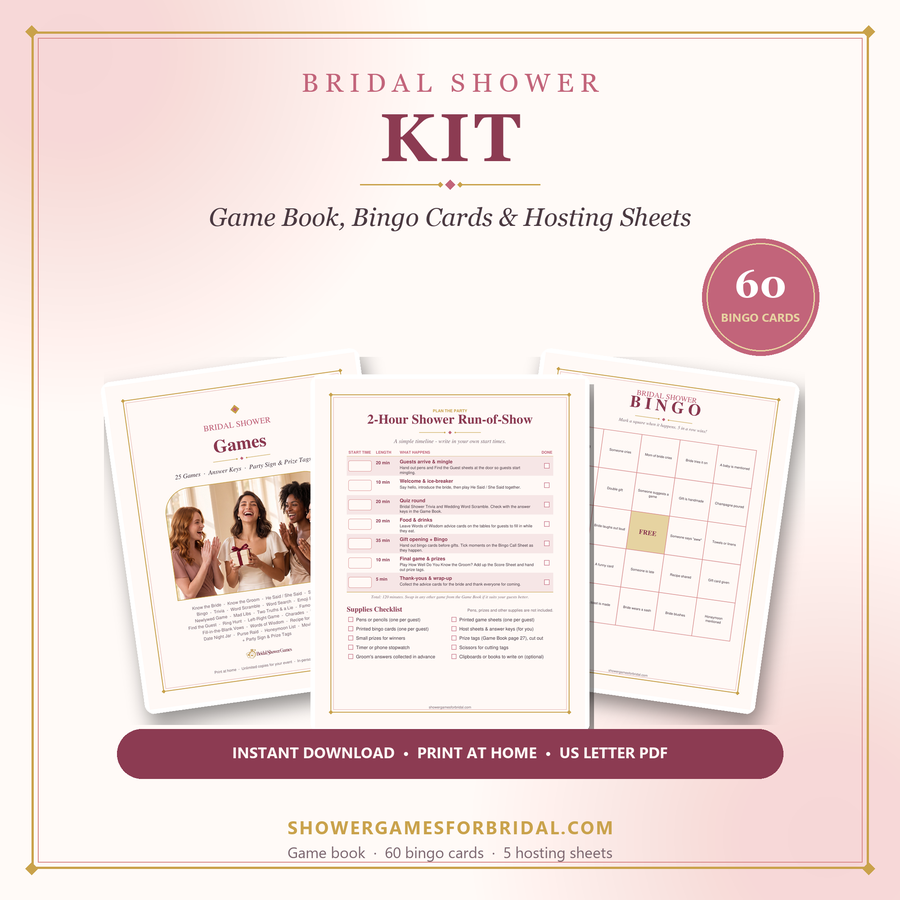
If you prefer designed paper activities, compare the paid packs below. Check each product page for its exact contents; not every browser activity has a matching printable.
For deeper planning help, see the guides on the main site: virtual & Zoom showers, funny games that aren't cheesy, games for large groups and co-ed & couples showers.